
Content Marketing



Why is Empathy So Important In Your Marketing? – Ask EZ
Especially during a crisis, people talk a lot about being empathetic in your marketing. But empathy is ALWAYS a critical part of your marketing message.

Should I be blogging for my business? – Ask EZ
This Week’s Question: It seems like everyone is blogging nowadays. Should I be blogging for my business?

How do I avoid being too salesy? – Ask EZ
This Week’s Question: I don’t want to come across as too ‘salesy.’ How can I avoid being a pushy salesperson?
Top 10 Writing Tools for Content Marketing You Need to Know
No matter what business you are in you can’t compete these days without great content marketing. These writing tools can help you work more efficiently.

How to Stand Out with a Unique Selling Proposition
In a crowded business world, it can be tough to stand out from your competition. Generic claims like ‘best quality,’ or ‘great customer service’ won’t cut it. Find out how to differentiate your business with a strong Unique Selling Proposition (USP).

The Time-Starved Marketer’s Guide to Easy Buyer Personas
Buyer personas: two words that can strike fear into the hearts of many marketers. The trouble is, a good buyer persona takes significant time and effort to put together. That may be all well and good for a large company with a robust marketing team, but faced with the daunting task of customer interviews, extensive research, and translating all that data into usable personas, busy marketers are tempted to skip the step entirely.
So is there a better approach that allows marketers to gain useful insights about their customers, without getting lost in the depths of endless customer research? We think so.
What is a buyer persona?
A buyer persona is a generalized representation of your ideal customer, based on actual customer data, that helps you better tailor your marketing strategy.
Buyer personas help you dive deeper to understand who your customers really are and what motivates them. This helps you focus your digital marketing, so you’re speaking directly to your customer’s needs and pain points. Because here’s the harsh truth: no one cares about your products or services unless you give them a reason to. A good buyer persona helps you uncover what your customer truly values.
Why bother with buyer personas?
When it comes to putting together a marketing strategy, most marketers will agree that identifying a target customer is important. But why invest so much time and effort in developing buyer personas?
First, creating buyer personas implies a shift in how you think about your customers. If you’re simply trying to identify a target market, you’re probably identifying who you think is best-suited to your products or services. Building a buyer persona means you’re putting yourself if your customer’s shoes, so you’re responding to what they want and need.
Furthermore, when most businesses talk about their ideal customer, they are focusing on a collection of demographics. While demographics may narrow down your audience, they aren’t as much help when it comes to creating strong, differentiated messaging.
For example, a beauty salon might say they’re targeting female professionals, ages 25-35, who are married but have no children, and have a household income of greater than $80K. Does this tell you something about their ideal customer? Absolutely. But does it tell you whether they’re interested in the newest styles and fashion trends, or if they’re looking for efficient in-and-out haircut? Not so much.

Source: VIEO Design Slideshare
Buyer personas are more than just a target market. They go beyond demographics to identify your ideal customers’ desires, challenges, and values, so you market differently to different types of people.
Your customers expect that sort of personalization. Whether your business is B2B or B2C, all marketing is person to person. The more you can understand and empathize with your customers, the better you can authentically reach them like a real human being.
How to build buyer personas that don’t take forever
Focus on the information that really matters
Sometimes marketers become so over-zealous in seeking to understand their customers that feel they need to know every single detail about their lives. Unfortunately, that means they often waste time collecting irrelevant data. We’ve seen interview questions that are so detailed they just get creepy (things like “what kind of parenting style did you grow up with?” or “were you a loner in school?”).
Remember that personas are generalizations. Unless you’re personalizing messages for every single person, you want to look for commonalities between individual customers that you can apply to a larger group. You don’t need to know intimate details about their personal life, or what their favorite breakfast cereal is. And unless you’re in a retail B2C business, traditional demographics like someone’s gender or marital status likely aren’t that important either.
If you have any doubts about whether something is relevant, ask yourself two questions:
- Does this substantially change how my customer makes decisions?
- Am I going to differentiate my marketing message based on this information?
Use a simple buyer persona template
While every business is different, and you may want to adapt this to your specific needs, here is the basic template we use for our buyer personas.
Keep in the mind that the questions you ask in each of these areas should be skewed toward the product or service you’re selling. If you’re in a B2B business, you’ll probably focus more on your customer’s professional life and how they evaluate business solutions. If you’re selling B2C, you’ll want to ask more about their personal goals and pain points.
- Overview
- Name
- Job title/function
- Basic demographic info (age, income, education, location)
- Background information (other relevant information like industry, experience, interests, hobbies)
- Day in the Life
- What does a typical day look like?
- What are they responsible for? What kinds of decisions do they need to make?
- Who else do they interact with in making decisions?
- What do they dedicate their time, effort and/or money to?
- Goals
- What do they want?
- What does success look like for them?
- What tools, skills, or resources do they need to achieve their goals?
- What do the value most in a product/service like yours?
- Problems
- What keeps them up at night?
- What prevents them from achieving their goals?
- What frustrates them most about the product/service area you’re addressing?
- What do they try to do to alleviate those frustrations?
- Questions/Objections
- What information do they need in order to make a decision?
- What are the most important factors they look for in evaluating a solution?
- What would prevent them from buying your product/service?
- Content Preferences
- How do they get information? Do they prefer certain channels or formats?
- When do they consume content? During the work day, or at home?
- How much communication do they want to receive, and how often?
- What sources do they trust?
To download a copy of this template, click on the link below.

How to research your buyer personas
Even if you’re crunched for time, you still need to invest the effort in doing research. If you want your buyer personas to be useful in guiding your marketing strategy, you can’t rely on guessing or making things up about your customers.
The best way to research your buyer personas is to talk to your buyers. Unfortunately, busy marketers don’t always have the time to conduct in-depth customer interviews. If you can invest the time, by all means, do it. If not, here are some quick tips to help you research your personas:
Talk to your sales team
Your sales team is on the front lines when it comes to interacting with customers during the decision-making process. Pick their brains about the how and why different people choose to become customers. Ask questions like:
- What kinds of different prospects do you interact with?
- What are the top most frequently asked questions you get from customers?
- What are they looking for from a solution like ours?
- Why do customers choose our solution over others?
- What common objections do you get from prospects?
Talk to your customer service team
This is one source marketers sometimes overlook. While your sales team might know the most about the decision-making process, your customer service team is most familiar with the ongoing successes and pain points with your current customers. They can have tremendous insight into what your customers find important. Here are a few things you can ask them:
- What are the most common complains you hear from our customers?
- What do they like the most about working with us?
- Who are our best clients? Why?
- Who are our worst clients? Why?
Mine your analytics
Check your analytics from any source you’re using for marketing: website, email, social media, or your CRM system, if you have one. What types of content are your customers looking at, or engaging with? Are they downloading certain pieces of content? What pages are your website visitors looking at, and what sources did they come from? Look for patterns that identify what information your customer finds interesting and relevant.
Ask for customer feedback in other ways
While not as efficient as knocking out your questions in an interview, you can get direct customer feedback in other ways. Develop a survey, and send it out via email (but note that you might need an incentive to get responses). Or, add an extra field to your online forms to ask customers about their biggest challenge, or their #1 priority when it comes to your product/service.
Use external sources
There are tons of places online where your customers might share information you can use to develop your buyer personas. Check questions sites like Quora or Yahoo answers for problems your inquisitive customers might be asking about. It might sound stalker-ish, but Facebook and LinkedIn are great places to learn about your customers – people share an enormous amount of information about themselves on social media. Look for industry blogs, and competitor’s content to learn about what others in your space are talking about. Depending on your business, you might even find that sites like Reddit have interesting discussions you can follow.
Next Steps
Buyer personas don’t need to be a source of fear or anxiety. Using our template or your own version, just start filling in information as you go. You’ll discover quickly that you’re identifying more about your customers than you ever knew.
If you need help in identifying your buyer personas for your business, we can help! We offer a variety of digital marketing services and we can assist you in developing your buyer personas to help build and grow your business.


10 Benefits Of Business Blogging
Blogging has been around since the beginning of the internet, but a lot of businesses still aren’t doing it. Either they don’t understand it, think it’s not worth their time, or they don’t have the resources to do it themselves.
If you’re not blogging by now, you’re not just behind the times, you’re in danger of extinction. This year, a majority of marketers rated blog content creation as a top priority, according to Hubspot. Why? Blogging offers a ton of benefits to your business that you don’t want to miss out on.

Is Your Content Marketing Strategy Working?
One of the core functions of great content marketing is to have a documented strategy that, when executed, offers solutions to your targets’ problems. When they’re presented with a conversion trigger, they’ll be much likelier to take an action. If none of the people who view your content take the next step in the customer journey, you may need to look into changing your content marketing strategy.
A documented marketing strategy is the driving force behind getting your content marketing to produce results that meet your company’s goals. Without market research, tracking, and documented goals, you are just performing tactics haphazardly without really knowing what is working.
Constantly create valuable, resourceful, and entertaining content to make your website visitors, email subscribers, customers, and followers more informed and committed to your brand. You should do this to gain their trust, which leads them through the customer journey of eventually converting, making a sale, and becoming a loyal long-term customer.
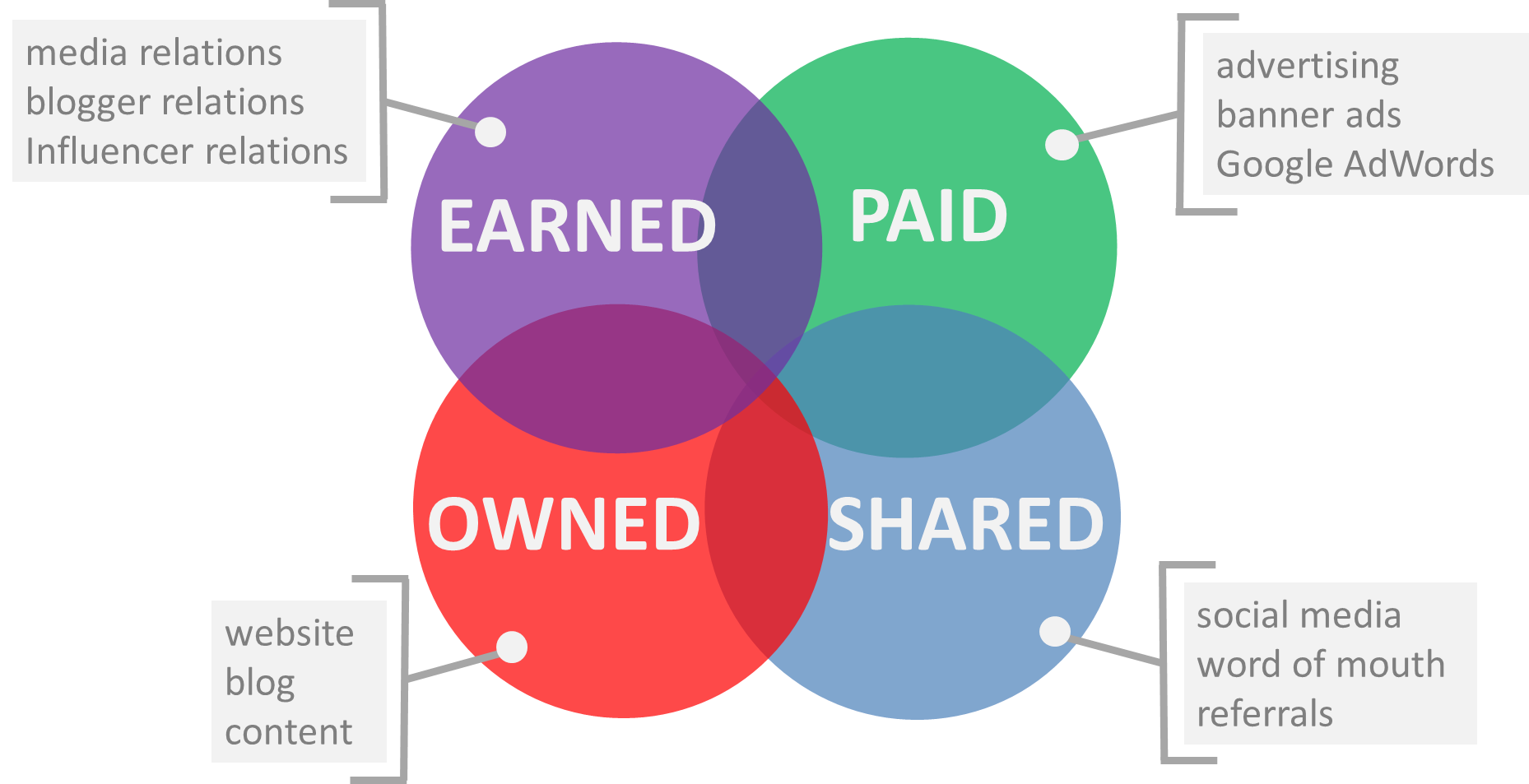
This is why content marketing has to be performed consistently across different platforms, including paid, earned, owned, and shared media – also known as the PESO marketing model.
 Source: Pear Analytics
Content marketing, defined by Content Marketing Institute, is “a strategic marketing approach focused on creating and distributing valuable, relevant, and consistent content to attract and retain a clearly defined audience – and, ultimately, to drive profitable customer action.”
In the business-to-business world, 88% of B2B marketers claim to be using content marketing as a tactic. In business-to-consumer industries, 76% of B2C marketers claim they are using content marketing.
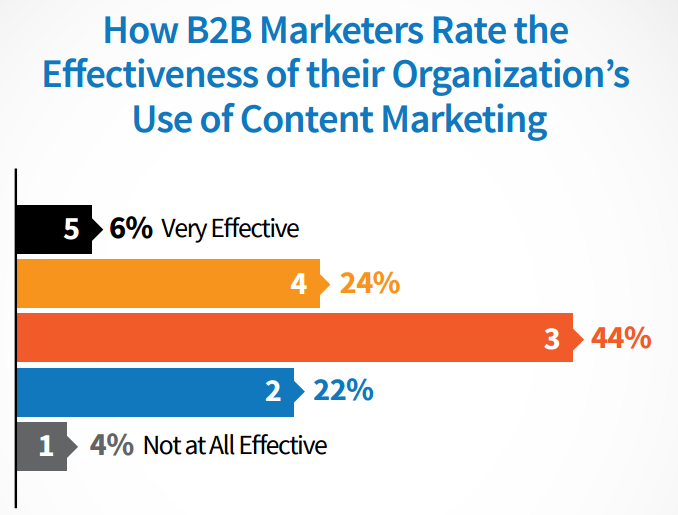
But only a fraction of those businesses actually think that their content marketing is achieving results that they want. Of the 88% of B2Bs who are involved in content marketing, 30% of marketers said it was effective or very effective, with only 6% of those claiming it to be very effective.
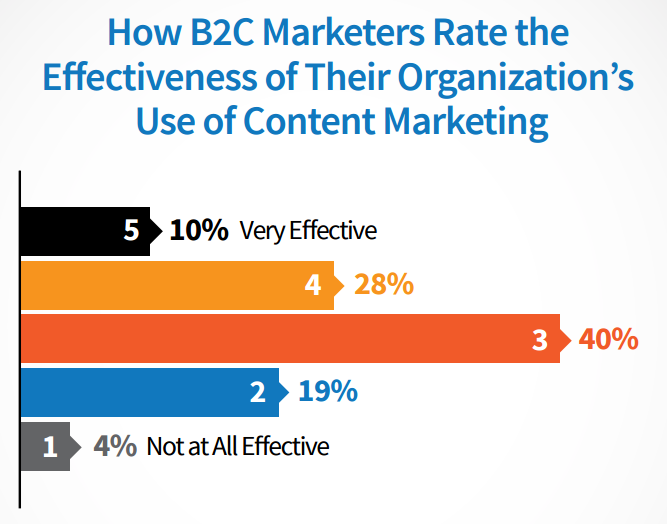
When it comes to B2C, 38% of respondents doing content marketing said it was effective or very effective, with 10% of those saying it was very effective.
What does this mean?
Across the board, over 60% of marketers aren’t seeing results from their content marketing efforts. A big reason for this is that they don’t do the research, know their target audiences, set goals, and track everything along the way in a documented marketing strategy.
Do you have a content marketing strategy?
A documented content marketing strategy is often the defining factor in whether content marketing succeeds or fails. In fact, without a documented strategy, you’ll only ever succeed by accident. Your strategy provides everything from data-driven research through to tactical execution, along with the analytics that show whether you’ve met your marketing goals.
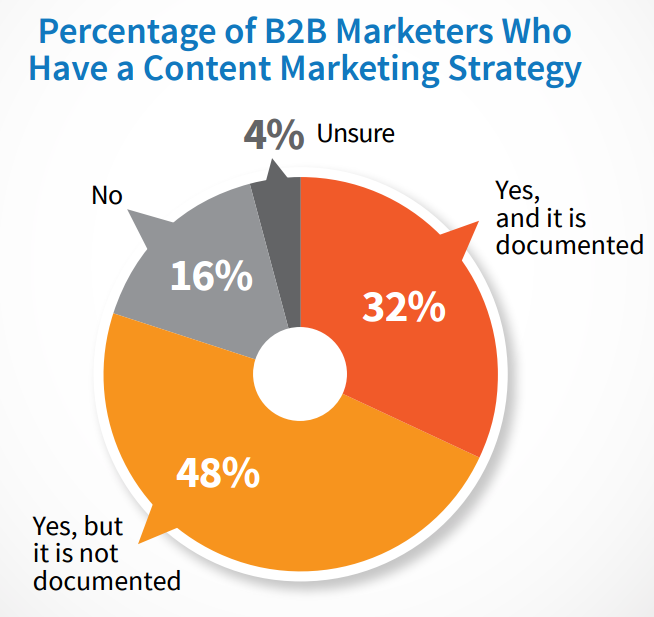
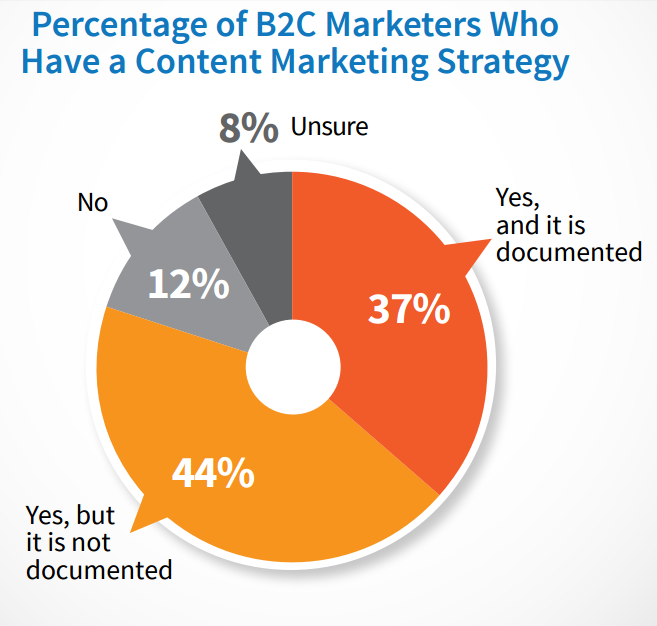
So how many marketers in B2C and B2B have a documented content marketing strategy?
- Only 32% of B2B marketers have a documented marketing strategy, while 48% have a marketing strategy that is not documented.
- In B2C, 37% of marketers have a documented strategy, while 44% don’t document their strategy.
Strategies keep your brand’s messaging consistent across all platforms, and tracking everything lets you know that what you’re doing is leading toward your goals. If your strategy is unrefined or nonexistent, there’s no way to ensure cohesive content marketing efforts.
Having a documented marketing strategy is the key to keeping everyone in your organization focused, so each employee knows exactly how their role plays out in an ongoing, collaborative effort. Some vague abstraction of a strategy that exists solely in the minds of one or two people on the content marketing team won’t serve the team as a whole.
EZMarketing’s brand strategist, Brandon Peach, had this to say about content marketing strategy:
“A content marketing strategy helps to tell the story of your business. It’s essential that a content marketing strategy be documented, since it’s been demonstrated year after year that content marketers who do so feel more effective, and can justify spending more on their content budget.”
Documentation is the proof that shows whether or not a marketing strategy is working, and if it is, companies are more willing to leverage a higher budget to continue evolving and optimizing their strategy.
Are you actively updating your content marketing strategy?
A strategy isn’t a once-and-done task. It’s something that needs revised and updated as the scope of your industry or business goals change. Strategy has to accommodate trends in the metrics you’ve measured, or the behavior of your target audience.
Your strategy should always be at the forefront of your mind and actions. It’s only natural for it to change according to key performance indicators (KPIs), the metrics important to your business, and when what you’re doing isn’t as effective as it could be.
The strategy that’s never updated is the one that can’t compete.
Do you have content marketing goals?
Consider why you use content marketing by asking yourself: “What do I want to accomplish?” You may have a strategy in place, but does it accomplish the goals you wanted to address in the first place?
A content marketing strategy should be born from the objectives put in place by the content marketing team. The chart below highlights common goals for B2B content marketers.

Your goals will define the specifics of your strategy. If your goal is lead generation and sales, then you might want to create more eBooks, case studies, and whitepapers in your content strategy to help generate more leads and sales.
In B2C, organizational goals are slightly different, with sales also being a top priority in all industries.
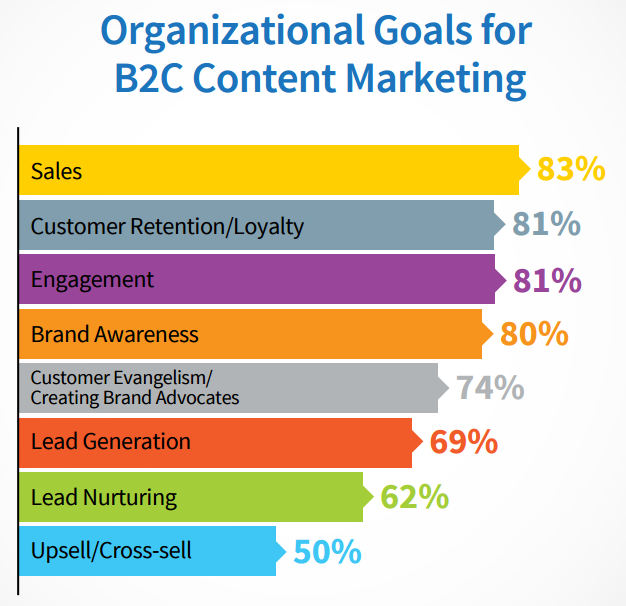
In B2C, if you want to focus on customer retention, then work on better customer service, and providing unique, relevant, and valuable content through email and social media to your subscribers and followers.
Objectives keep a marketing strategy goal-oriented and your content marketing results-driven.
Are you promoting your content?
Promoting content is one of the two key parts of content marketing: creation and promotion.
While your content marketing team may be churning out great content, if the process ends there then content marketing simply isn’t working hard enough for you. In fact, it’s probably not doing anything at all, because you haven’t taken the next step, which is promoting that content.
Most experts say you should spend just as much time, if not more, promoting your content as you do creating it.
What are some ways to promote your content?
Social media promotions, email marketing, influencer marketing, and industry outreach are all great ways to promote your content.
Writing a new post for your blog or publishing a cutting-edge eBook to your website isn’t enough. If your website has a strong following, then your current audience may find it – but your target audience who isn’t aware of your brand probably won’t. If your competition is creating helpful content, they will be found before you will be.
You can promote your content through paid content promotion services like Outbrain, or targeting specific audiences in Facebook or Twitter to get the word out. Also, reaching out to industry publications, bloggers, journalists, and writers to let them know about your content and how it may be helpful for their audience. Figuring out the sites to place your content where your target audience visits takes a bit of work. But Rand Fishkin from Moz explains how to discover the sites your audience visits in this extremely helpful whiteboard video.
Marketers who spend more time promoting their content on the right platforms and websites will see more success than businesses who spend more time creating and not enough time promoting.
Are you spending enough on content marketing?
As we’ve said above, too few companies think that their content marketing is actually effective. Those same companies may not be spending enough money or time on their content marketing either, which can be a contributing factor to their lack of confidence (and results).
If you’re spending a minimal amount on content marketing, then it’s difficult to expect it to do everything it’s supposed to do as effectively as you need it to. Content marketing is about ROI, and if you’re not investing enough, you won’t be seeing those huge returns.
So what percentage of marketing budgets are being spent on content marketing?
For B2B, the average is about 28% of marketing budgets that are being spent on content marketing. The marketers that found content marketing to be the most effective were allocating 46% of their total marketing budget on content marketing.
Are you spending almost half of your marketing budget on content marketing? Those that see the best results are.
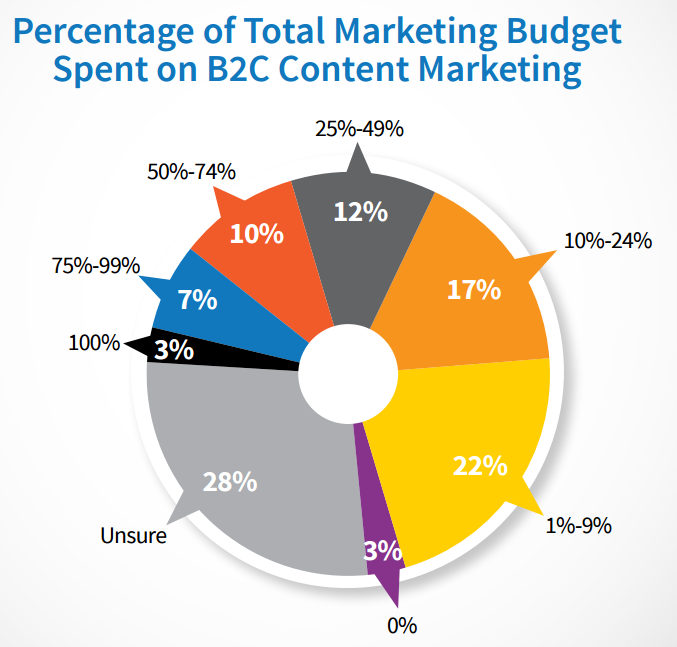
In B2C, 32% of marketing budgets are being spent on content marketing. The most effective marketers say that about 38% of their marketing budget is being spent on content marketing.
So what are you allocating from your whole marketing budget on content marketing?
It’s been shown that companies with strategic content marketing generate a higher percentage of leads than companies who don’t.
Ask yourself: “Is my content marketing working for me?”
Here’s the bottom line. If your content marketing isn’t working for you, it could be any number of things—from a nonexistent strategy, lack of promotion, a stifled budget, or unclear objectives and goals.
If you’re still wondering about where your content marketing stands, contact EZMarketing and we’ll do more than just develop content for you—we’ll help you create the strategy that gets results. Our Lancaster digital marketing agency offers content marketing a core internet marketing service.
