

Brand identity is the torch that lights the way for your company. It provides messaging, voice, and direction, becoming the umbrella under which all other elements will be shaped. If your brand identity was created using a flawed process, it could be damaging your business’s chance at success.
Branding & Design
Brand Story: A Definitive Guide
Harland David failed at everything he ever attempted.
- He failed at school.
- He failed as a fireman.
- He failed as a lawyer.
- He failed at selling life insurance.
- He failed at selling tires.
- He failed at manufacturing.
- He was fired from a dozen jobs.
At age 65, he was left with only a modest savings and $105 a month from Social Security.
But that was the year that he stopped failing. At 65 he began franchising businesses using a special recipe he’d created, and by 73 years old he was able to sell that business for today’s equivalent of $15 million.
$15 million for Harland David Sanders. You know him as Colonel Sanders. His famous recipe, Kentucky Fried Chicken, made him a legend.
How Infographics Can Benefit a Digital Marketing Strategy
Google and other major search engines continue to redefine their ranking algorithms, making it harder and harder for brands to create high-quality content that receives links and rank organically. Marketers need to continuously find ways to naturally generate authoritative and relevant links for their content and websites.
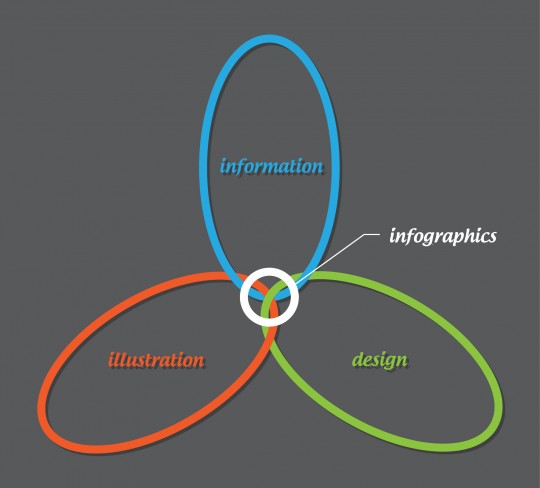
When link building becomes more about link earning, the focus needs to shift to creating exceptional and helpful or entertaining content. Bloggers and website owners rarely want to link to something that’s not valuable to their own business or blog. Nor do they want to link to your products or services, since such content is promotional in nature and in most cases doesn’t help their audience. One of the best and most popular ways marketers are creating this standout content is with infographics. An infographic is a visual representation of content and data, presented in an appealing, thought-provoking way.
From Visually.
Creating truly helpful and visually appealing content is one of the best ways to increase brand awareness, build your audience, aid in lead generation, and improve conversion rates across the board.
Growing brand awareness
You want your brand in front of your target audience, especially those that don’t know you exist. What’s a good way to do that? Infographics work so well on the web because we live in a world of instant gratification. People are more inclined to share visual pieces of informative content because it’s scannable and appealing—giving searchers a solution in the form of a graphic.
Searchers want instant answers. They’ve become accustomed to search engines returning the information they want in a matter of seconds.
When a brand is new online, or hasn’t been using content marketing or SEO, they’re usually not showing up anywhere close to the top of the search results. This means they’re missing the ability to answer the searcher’s problem, and losing the opportunity to turn them into a valuable lead.
Instead of only focusing resources on creating long-form content, no matter how valuable it may be, new brands should also focus on creating easily digestible content.
Infographics can help your content to stand out from the crowd, especially since there is so much noise out there. Your content, whether it be infographics, videos, blog posts, or anything else, needs to be better than whatever already exists online.
You can see from the Google Trends comparison above that searches for content like “white papers” continue to lose popularity, while searches “infographics” steadily rise in its place.

New brands and online businesses can actively benefit from creating and marketing an infographic. Infographics help turn your message into a visual, digital format that’s ideal for sharing. And when people can easily share your content, they help to expose more and more potential customers to your brand.
Increase in organic search traffic and rankings
When you create infographics that help or entertain those in your industry, influencers, bloggers, writers, and journalists in the same niche will share it with their audiences. By doing so, they mention and link to your site to credit the source.
The more authoritative websites in your industry that link to your site help to increase the overall organic rankings of your website. It shows Google and other search engines that authority sites trust your site by linking and mentioning you, and since Google recognizes those sites as authoritative, it passes along that trust with increased rankings for your site’s related keywords. Because, as mentioned before, Google is all about giving the user the most relevant information as quickly as possible when they search it.
For example, when our infographic on the evolution of arcade games went on Wired and other websites, a lot of their keywords related to arcade games all saw an increase in rankings.
Infographics are easy to post on your website by using an embed code that pastes the image onto you a page and includes a link back to the original source. The best kind of link is a contextual link; that is, one where a writer, blogger, editor, or journalist writes a piece and includes a text link to your source. But the easiest kind of backlink for infographics is the one from the embed code, since all that has to be done is to copy and paste the embed code to the site.
Aiding in lead generation
The best marketers know that right content needs to be presented to their potential customers at exactly the right time for every stage of the customer journey. A potential customer beginning to research a big investment, like adding a swimming pool to their backyard, probably isn’t ready for an eBook detailing different pool designs and features. Instead, presenting them with an infographic about interesting swimming pool facts can be the perfect way to expose them to your brand and move them through the sales funnel.
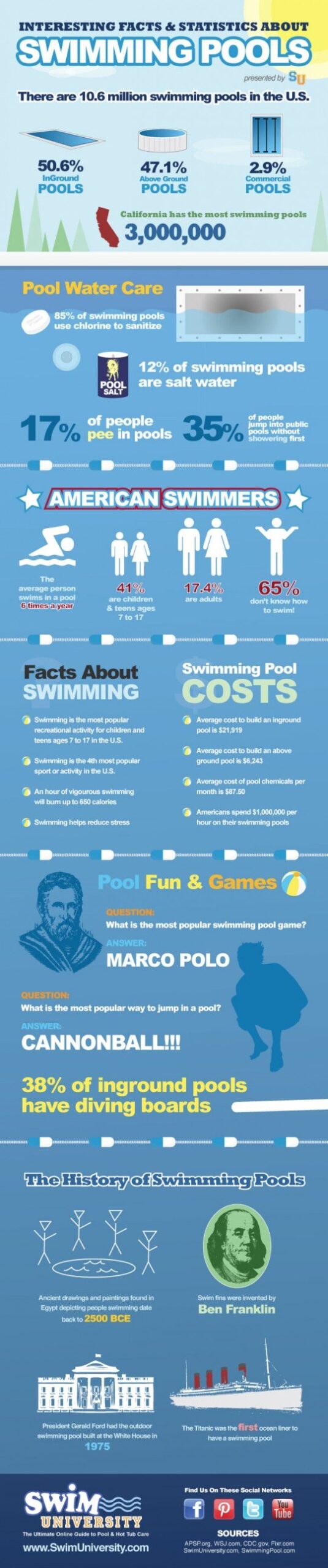
Content like this is at the very top of your funnel and avoids diving right into a sales pitch. When you try to sell a potential customer on your product or service too soon, in most cases, they’re no longer a potential customer (as they weren’t ready to buy yet).
Informative infographics rarely turn potential customers off. They work to give these people entertaining, valuable information while subtly nudging them closer to your brand.
While a good infographic helps to move your potential customer through your sales process, it also works to generate leads in other ways. That customer may have found your infographic so useful that they want to share it with their friends on social media, through email, or maybe even post it on their blog. When your infographic is shared, your brand awareness goes up, and so does your ability to attract new leads to your business.
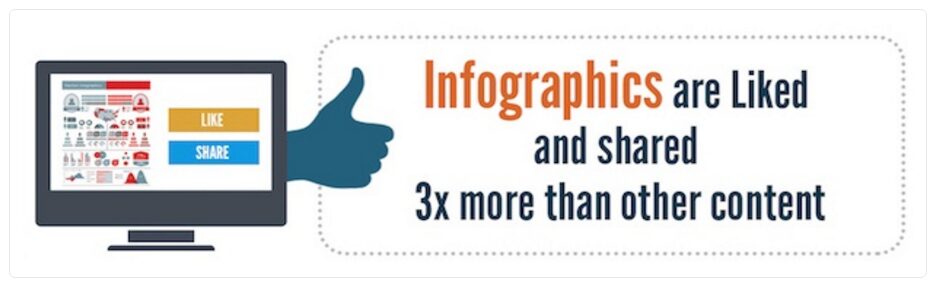
If your potential customer is finally ready to buy, they’re more likely to go with a company that has helped them with informative and useful content along their journey. Infographics not only help to present information in an appealing way, they also help increase trust with your potential customers. Customers are more likely to buy from a company they trust over someone they’ve never interacted with before.
Improving conversion rate
Now more than ever, gaining the attention of customers online is about earning it. Rather than bombarding potential customers with spam emails, irrelevant offers, and overly “salesy” tactics, you’re allowing them to discover you in their own way.
Infographics aid not only in the discovery of your products and services, but also your ability to convert leads into sales.
Content should be created to fill a need in your industry and/or to entertain, to answer a common problem or concern your customers have in the best way possible. Using an infographic to communicate content is one of the best ways to naturally draw people into your site or blog.
Good content tends to cause a chain reaction: people share your infographic, link to it or embed it on their website, exposing new customers to your brand, gaining links to your site, improving your rankings, leading to more traffic.
“Businesses who market with infographics grow traffic an average of 12% more than those who don’t.”
This chain reaction ultimately leads to increases in traffic to your site from other relevant sites in your industry where your target market is visiting. And, when more people from your target audience are visiting your site, your chances at gaining a conversion are that much better than before.
Few long-form pieces of content have the ability to gain customers’ attention, encourage shares, and increase brand trust as much as infographics. When you take the time to build an infographic with valuable information, you’re filling a void and giving customers exactly what they want. There’s no better way to encourage a conversion and build a strong long-term relationship than that.
For help with defining and creating your overall digital marketing strategy, contact the marketing professionals at EZMarketing today.

How Offline Branding Supports Your Online Marketing
Offline branding, as well as traditional marketing materials and channels, continue to demonstrate their value to businesses large and small. Companies may have adopted larger digital marketing strategies, but print, TV, and radio still hold sway when it comes to capturing interest in a company’s brand.
When integrated into your overall marketing strategy, offline branding enhances the scope of your reach and can guide leads into the sales funnel. The real benefit to offline branding efforts is being seen by part of your target audience, a segment that might have potentially missed your digital marketing campaigns up until that point.
How to bridge the gap between offline and online marketing

They key to successful marketing is using offline and online branding strategies to complement one another so that you cover potential weak spots in any given ad campaign.
Offline branding can be essential in guiding your prospects through the customer journey, from the real world to the digital. A billboard could lead someone to a website where they make a purchase.
That’s what successful offline branding looks like.
While that’s a good example of successful offline branding, it’s important to understand that your offline marketing materials should pave the way for a customer’s online exploration. A prospect should be able to take something away from your TV commercial or print ad that will lead them to your website or online store.
There’s also the chance that your end game won’t lead them to a website. Maybe you’re drawing them to a physical location, or encouraging them to make a phone call. Wherever you want your offline branding to take leads, it has to share the same direction and messaging as the rest of your collateral.
Offline and online may be two different worlds but your brand should possess a single, united voice. Inconsistencies between the two could confuse or alienate potential customers.
When offline branding succeeds
Trade shows, community events, and conventions provide companies with unique offline branding opportunities that allow businesses to meet with peers or customers in person, letting others put a face and personality to the corporation.
Gaining contacts or becoming part of an organization can lead to directory listings, or becoming a member and having your business mentioned through a link on the group’s website. In terms of ROI, this association and endorsement is great for the amount of time or money it takes to attend shows or run booths.
Car and truck wraps are another example of offline branding that can be optimized for your digital marketing campaigns. Including keywords you’ve optimized for online use along with your URL creates an intrinsic connection between offline and online. This sense of cohesion in your marketing tactics is what leads to conversions.
When offline branding fails
Offline channels still play a fundamental role in marketing. Media such as TV, radio, and print ads continue to drive online searches. However, they’re not always optimized to capitalize on the content you’ve published online. Someone might try Googling a phrase they heard in one of your commercials and wind up with any result but the website they wanted to find.
Offline collateral featuring brand mentions should be optimized for your website and landing pages. If you’re using keywords or phrases in your offline branding that don’t appear on your website then people won’t know how to find you online or learn more about your business.
When people have search queries, something online has to answer those—like a landing page specifically for an offline marketing campaign. Likewise, your digital marketing should be capitalizing on any printed materials and ads.
Checklist for optimizing offline branding
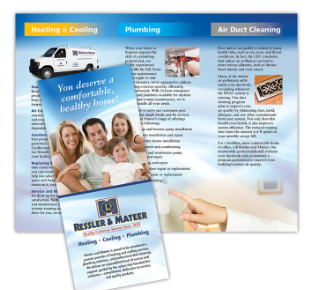
To ensure your digital marketing is benefiting from your offline efforts, follow this helpful checklist.
- Spell out your URL. On the radio, on billboards, it doesn’t matter—spell it out so people can easily remember and write it down.
- Words included on any printed material (ads, billboards, car wraps) should be keywords already optimized for content on your website. Don’t introduce any new terminology that wouldn’t point towards your site in a search.
- Optimize websites for ads run on the TV or radio. Anything someone might have heard or seen in one of your ads should be useful in a search to find you and your content.
- Take control of your video content. If you’ve aired commercials, make sure you’re the first to upload them to sites like YouTube and remember to embed the video on your website as well.
To ensure both your digital and offline marketing are coordinated, make sure that they share enough similarities, like keywords. Using keywords linked to your online content is the most efficient way to lead your customers from an offline piece of branding back to your website. Prospects will be left confused, frustrated, and with a sense of disconnect if one piece of marketing doesn’t lead to the other.
Learn how to coordinate your offline branding strategies with your online marketing tactics. If your customers see a print ad or TV commercial, you’re starting a conversation with them—one you should be able to finish online. Collaborate with the professionals who know how to coordinate your digital marketing efforts with intelligent, results-driven offline branding.
Our Lancaster marketing company works with clients on traditional and digital marketing campaigns. Give us a call to get started.

How Professional Images Help Persuade Potential Buyers
Professional images help make your business stand out, whether they are digital or in print. Find out how they can help persuade your target market to buy.

Lackluster Logos: 4 Signs You Need a Visual Update
If your logo is a visual representation of your business, then a poorly designed or outdated logo is like suffering an identity crisis. Prospects will lose touch with who you are or what you do. So the question becomes: “how do I know if my logo needs to be updated?” Advertising evolves with consumer and technology trends, so it’s natural to consider whether your logo needs an update. Companies have to adapt to survive, after all.
Logos create a sense of trust, and signal things like quality, value, and popularity. Just consider how consumers treat brand recognition—placing more value on a product’s logo than the product itself.
A recognizable brand is one the consumer is already familiar with, and is one they’re more likely to favor or trust. As a representation of your business, your logo is a key element in your visual branding, one that allows people to form an emotional association with you and your products or services.
Not feeling your logo anymore? Think it’s time for a change? Ask yourself these four questions to see whether your business logo needs a facelift.
1) Does it reflect my company’s brand identity?

Perhaps you’re in the middle of a rebranding or you’re simply not sure if your current logo still communicates, but an important question to ask is whether the logo adequately (and accurately) represents who you are as a business. In other words, your logo should tell your story.
If your brand identity changes, the logo might need to change as well to ensure uniformity of message.
Bottom Line: Consider changing your logo if it doesn’t reflect your company’s identity or current brand.
2) Does it help me stand out from all the other businesses?
It can be difficult standing out in a crowd of snowflakes, but there are plenty of companies who’ve managed to do just that. Like domain or business names, being unique makes you easier to find and remember.


Some of the most popular brands have the most iconic logos. Apple, Nike, Coca-Cola—consider how ingrained these brands have become in our culture. Their logos often represents an entire category of product in the minds of consumers.
Bottom Line: If your logo is blending in with the rest, it might be time for a new one.
3) How does my target customer feel about my logo?

You might be in love with your logo, but do your customers share that feeling? Maybe it’s your employees who are less than thrilled about the design. Lackluster logos can diminish a company’s visibility and cause prospects to turn toward a more recognizable, visually pleasing design instead.
Take Target’s logo, for example. They have something of an edge over other stores because of their easily recognizable brand symbol, which is a logo that can stand on its own without the store’s name or other words. It basically speaks for itself.
In a world where consumers favor visuals over words, a logo can make it that much easier—or more difficult—for a brand to succeed if the people love it (or don’t).
Bottom Line: When your employees, customers, or prospects begin to react unfavorably toward your logo, consider changing it up.
4) Does my logo work across all channels, from print to digital?
There are plenty of companies that got their start before the digital age. That means their logos weren’t originally optimized for the web, so over time they probably realized that the tried-and-true logo didn’t look too great online.
As computer technology improves, outdated graphics start to show their age. Low resolution, bad colors, and poor choice of fonts can render an otherwise attractive logo ill-suited for use across media large and small.
For a logo to really shine it should be viewable on all channels without being turned into a pixelated blob. When your company has a logo usable online, in print ads, social media, and billboards, you’ll have a logo that can endure. It won’t matter where your customers see your logo: they’ll recognize it and know it’s yours.
Bottom Line: Look for a new logo if you’re an older company whose logo was only designed for use in print, or if your logo doesn’t quite look right on other websites and print material.
Conclusion

Some logos may only require a small bit of polishing, whereas others could stand to be redone entirely. Either way, your company—your brand—is bigger than its logo; and your logo works for you, not the other way around. Don’t let your business be held hostage by a poorly designed or outdated logo. Our graphic design team has developed hundreds of bold, brand-appropriate graphics to represent our clients’ companies. We can help revitalize your old logo while sticking to the vision that best expresses your business and mission.
Picture-Perfect: Why Quality Graphic Design is Critical for Your Business
Your prospects’ awareness of your company is everything. It means visibility and exposure, and having a presence customers recognize and can relate to. If no one knows who you are then you can’t establish yourself as an authority or expert in your industry. And that means no one will care about who you are or what you have to offer.
But it doesn’t have to be that way.
Increasing brand awareness is a problem many businesses are faced with at some point. The fix usually requires the company to address one or more visual aspects of their marketing strategy, such as a logo, website, or even a lack of visual content. Branded products are arguably one of the most effective tools a marketer has in their arsenal, and a company’s logo has the power to evoke the entire company’s identity without saying a word.
Without visual content a company only has its words and reputation. But, in an age where prospects demand shorter forms of content and eye-grabbing visuals, companies have to evolve if they want to boost their visibility and the public’s awareness of their product or service. So, what’s the answer?
Hire a graphic designer.
Professional Graphic Design
A talented graphic designer can change perspective, and that’s the kind of power companies need in their marketing lineup. Visual content redefines short-and-sweet by packing information and visual stimuli into a single, easily easy-to-swallow package. Infographics are a prime example of visual content at its best. It gives companies a creative way to display copy or hard data in a digestible, attractive way. They’ve become so big that in 2014 alone, the use of infographics was more than 5 times higher than it was in previous years—from 9% to a whopping 52%.
The art of graphic design includes more than infographics. From photography to videos, visual content includes both visual and interactive content, including presentations like slideshows and webinars. The popularity of websites such as YouTube, Tumblr, and Pinterest should vouch for the average internet user’s interest in visual content. Companies can capitalize on that information by adopting visual content into their marketing strategies.
Your company’s level of exposure—the degree to which the public is aware of you—requires being seen. You need to have impactful visuals to draw the attention of your ideal customers and keep them engaged. Investing in professional graphic design can help you achieve that.
Visual Content is on the Rise
 Visual content was cited as a key component in each of the top B2B marketing tactics that included videos, case studies, and webinars. Look at it this way: 93% of all human communication involves visual content. It’s no wonder. The brain can process visual information so much faster than it can text. Other companies are slowly gravitating away from longer forms of content such as whitepapers in favor of shorter, visual/interactive content.
Images already rule social media marketing. Facebook and Twitter are saturated with photos, making images and photos an invaluable social media tactic.
Boost Your Company’s Exposure with Printed Materials
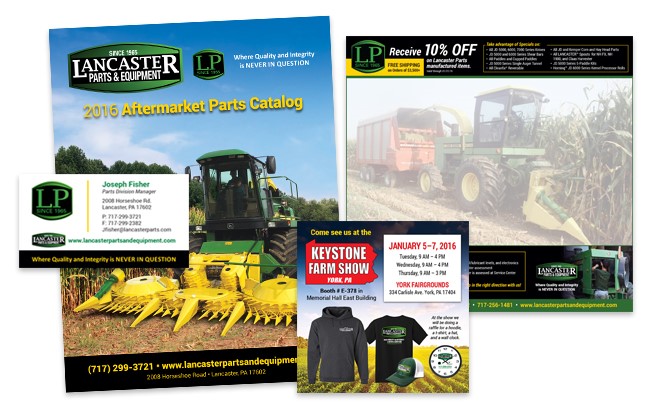
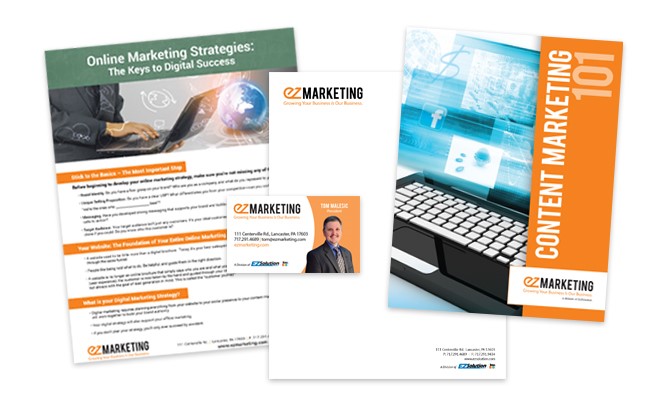
Graphic design isn’t purely digital, and a good designer can create more traditional marketing material that inspires our customers to remember you. Visually stimulating, print is tactile and offers access to memory and information. Online, an ad might pop up and disappear in a matter of minutes, but a business card or brochure can be picked up at any time. Customers have the freedom to engage with you whenever they want to, allowing them to remember you or access important information about your company. And now that so many businesses are going digital with their marketing, print stands out even more. Professional graphic design can easily benefit both digital and print campaigns, so take advantage of its versatility before your competition does.
DIY: Hire Professional Graphic Design
Just because you made a couple of cool doodles doesn’t mean you should also create your company’s visual content. Graphic design includes knowledge of typography, color theory, layouts, and the right tools. A professional designer has the ability to implement these things in a provocative but cohesive way; to execute designs with a creative vision appropriate to a company and its brand.


4 Things Your Logo Communicates About Your Brand
What do you think of when you see a logo? The Golden Arches, perhaps, the Nike swoosh, the mermaid on a cup of Starbucks coffee. The power of a logo is not to be underestimated: your logo communicates many, many things about your business. Everything from the typeface to the color to the placement of various elements says something, which is why poor logo design is something to be avoided at all costs.
Here are four things that your logo communicates about your company’s branding.

Branding Strategy 101
Determining your brand strategy is critical for your business. Before any social media, logo development, email campaign, content marketing, or anything else, you must determine the direction your company’s brand will take.
You’re probably thinking, “But we already have a logo! We’re already doing social media! We’ve sent out email blasts and just launched our new website!”
You might not even know what some of the above terms mean – but don’t worry! Although branding strategy is an extremely important thing for a business to do, just because you’ve already started doesn’t mean you can’t develop your branding strategy (along with your fellow employees) right now.
Let’s talk Branding Strategy 101, and the steps you can take to develop a unique, powerful, creative, and engaging brand that your target market will associate strongly with your business.
What is brand strategy?
Simply, brand strategy is the who, what, where, why, how of your company. It’s built around the goals of your company, and it identifies the things that you stand for. Sure, your logo, company name, slogans, colors are a part of your brand strategy – but they’re not the whole package.
For instance, think of an iconic brand like McDonald’s. You probably think of red and yellow, golden arches, Ronald McDonald, or the phrase “I’m lovin’ it!” If you think hard enough, you might think of the “two all beef patties” campaign, or the Halloween buckets they used to distribute.

But there are other things that characterize McDonald’s, too. It’s the quality of the food (love it or hate it). It’s the consistency of the food – what you get in Santa Monica is the same as what you’ll get in Washington D.C. It’s the customer service. It’s the time it takes to get your food after you order. It’s the dollar menu, the product names – McMuffin, McRib, McNuggets, McFlurry, Big Mac.
You know what to expect from McDonald’s, because their brand strategy is their promise to you, the customer. What is your promise to your customer?
Defining your brand
The first thing you must do in your brand strategy is to define your brand or to “develop a brand profile.” In other words, if you went to everyone in your company and asked, “What is our brand,” would you get the same answer from everyone? If not, get your employees together and begin asking the tough questions.
- Who are we? What is our mission or goal?
- What’s different about our products and services?
- Who is our ideal customer?
- How do our customers feel about us?
- How about people who don’t want to work with us?
- How about the competition?
- What do we want people to feel when they think about us?
- Why do our customers choose to work and to stay with us?
Once you know the answers to these questions – and others like them, depending on your business – you’re ready. If you don’t have the answers, get them!
Please know that this process can be very uncomfortable, especially for owners or managers, but it’s also very necessary. If there are things that you think customers associate with your brand, but you’d rather they didn’t – for instance, slow service, poor product quality, or even your employees’ attitudes – this is when you can begin developing a plan to change those things. If your brand is a promise to your customer, you need to determine what you want to promise them.
Establishing your identity
Now that you’ve identified your brand, and you know what you want your brand to be, it’s time to authenticate your identity.
The trick here is to verbalize and to demonstrate what it is about your business that makes you unique, relevant, and able to exceed the expectations, needs, and desires of your ideal customer.
What’s so exciting about this step is that you can reinvent your brand and turn it into anything you want to – or you can capitalize on the amazing things you’ve already been doing that your customers already love. It also gives you a chance to decide, since you know who you are and what you want your personality to reflect.
When you establish your identity, you’re going to want to determine a very important keystone of your branding strategy – your unique selling proposition, or USP. A unique selling proposition is a short declaration about what differentiates you from your competitors and demonstrates why customers should choose you.

Some famous USP’s include the following – how many can you associate with a particular brand?
- Better ingredients. Better pizza.
- Melts in your mouth, not in your hand.
- Save Money. Live Better.
- 15 minutes could save you 15 percent or more on car insurance.
- Like a good neighbor, ________ ________ is there.
In order, these USP’s belong to Papa John’s, M&Ms, Walmart, Geico, and State Farm. Now, it should be noted that these also serve as slogans. When you develop your USP, think more in terms of the value your business offers that your competitors don’t. For instance, consider the following.
- Do your products cost less, but they’re of a higher quality?
- Does your service offer an unbeatable guarantee?
- Are customers telling you your service is far better than the competition?
- Are your offerings unique or handmade that can’t be found anywhere else?
When your identity is established, the last and final step will be the most rewarding for you because you’ll be able to execute with confidence.
Hit the ground running
Everyone in your company now knows how you’re defined, what your identity is, and you’ve got a unique selling proposition to back it up. Now you get to execute. Before you take your brand to the world, develop the emotional, visual, and practical stuff people will strongly associate with your company.

- Come up with a color palette and a logo.
How do you want your brand to look? Big, bold, glossy? Muted and subdued? Professional? Innovative? Now you get to decide! We recommend that you use a professional to help you determine how your brand should look, just in case you feel in a couple years that your logo is dated or unsophisticated. - Determine your voice.
How will your employees sound on the phone? How about in emails? What will your web copy sound like? Your brand needs to have a voice that reflects your whole company, whether it’s quirky and informal (Red Bull) professional (The Law offices of XYZ), or somewhere in the middle. This voice must carry across all your communications. - Develop a slogan or a tagline.
Again, this probably won’t be your USP, but try to make it reflect what your USP is in brief. For instance, “Every kiss begins with Kay” is Kay Jewelers’ slogan, but it isn’t a USP. However, this slogan does hint a critical part of Kay’s brand – creating that magical moment when you share a precious gift with a loved one. - Create materials.
Your website, uniforms, brochures, email signatures, and more are all a reflection on your brand. Have a designer come up with a way to unify all of these materials under the umbrella of your brand, the entire look and feel of what you do. Make sure that you’re consistent in the way your brand looks across multiple media. Remember, you don’t want to confuse people – you want them to identify.
There you have it – a brand strategy that you, your employees, and your customers will identify as uniquely you.
For more about branding, check out our pages developing branding strategies, logos, and printed materials. If you’re looking for marketing companies near you, give us call. Our marketing agency in Lancaster helps small business owners with online and offline marketing.
Your Brand Is More Than A Logo
Today, buyers of a business’s products and services are searching for the authentic. That’s why it’s critical that the products and services a business provides are consistent with its image.
“Image” in today’s culture is generally only important when it is steeped in reality. In other words, people are far more inclined to do business with an organization when they’re certain that “what you see is what you get.” The age of hype is over! Say what you are. Be what you are. And be very sure there is tight correlation between the two.