Blog


How To Generate Leads Online With Your Website

Your website can be a powerful tool to generate leads for your business – if you use it correctly. Unfortunately, many businesses don’t optimize their websites to convert leads. The result: missed opportunities and missed sales. Here are a few ways to effectively generate leads with your website design – and some pitfalls to avoid.

Read more

The One Reason Your Content Marketing is Failing

Nearly all businesses today are doing some form of content marketing – 91% according to the most recent industry study. Despite that, many marketers are still not seeing the results they want from their efforts. They write blogs, but no one reads them. They send out emails, but no one opens them. No one will like their Facebook page or follow  them on LinkedIn.

Maybe that sounds familiar. But with 79% of marketers saying they’re seeing success from content marketing, what are you missing? Why is your content marketing failing?

The answer: strategy. Specifically, a documented content marketing strategy.

Strategy Supports Success

Sometimes, content marketing can seem like a hungry beast – one that constantly needs to be fed. When you’re struggling to keep up a weekly blog, or regular social posts, it’s hard to stop and think about strategy. It’s no surprise that many small businesses (who often only have tiny or one-person marketing teams), end up doing random acts of content. They focus on feeding the beast, one blog-post morsel at a time, rather than figuring out a long-term strategy.

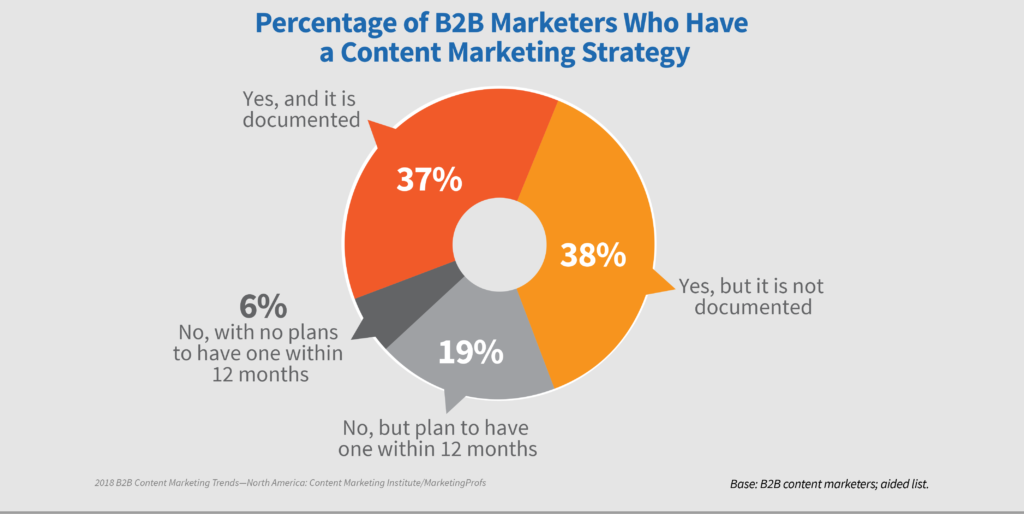
Studies have proven, year after year, that a documented content marketing strategy is critical to success. Only 37% of B2B marketers have a documented strategy, yet 62% of the top performers have invested in one. What’s more, 72% of respondents said that strategy contributed to increased content marketing success over the last year.


Why Do You Need A Documented Content Marketing Strategy?

First, note the word documented. You need to write it down, otherwise it’s just nice ideas. The process of getting a strategy down on paper will help create alignment in your organization. Plus it’s harder to forget something in writing.

But why do you need a strategy to begin with? Here are a few reasons:

You Need to Be Remarkable

There’s a lot of content out there. Every month, WordPress users alone produce nearly 82 million blog posts. Every minute, people send 156 million emails and view  4.1 million YouTube videos.

Whatever you want to say has already been said. Probably many times over.

Your job is to bring your unique story and perspective to the content. You need to answer the question: why should anyone care?

Rand Fishkin of Moz tackles the question by talking about 10x content: the idea that in a world overloaded by content, producing “good” content isn’t enough anymore. You need to create something that’s 10 times better than everyone else.

As Fishkin points out, however, you don’t just do this by accident. 10x content requires planning, research and time to succeed. It needs strategy. Otherwise you are just like one small fish in an enormous ocean.

You Need to Be Radically Relevant to Your Customers

We don’t just produce a ton of content. We also consume a ton of content. Remember those 82 million blog posts per month? WordPress also reports that people view more than 21.3 billion pages per month. So it’s not that your customers aren’t consuming content. They just might not be consuming your content.

The problem is relevance.

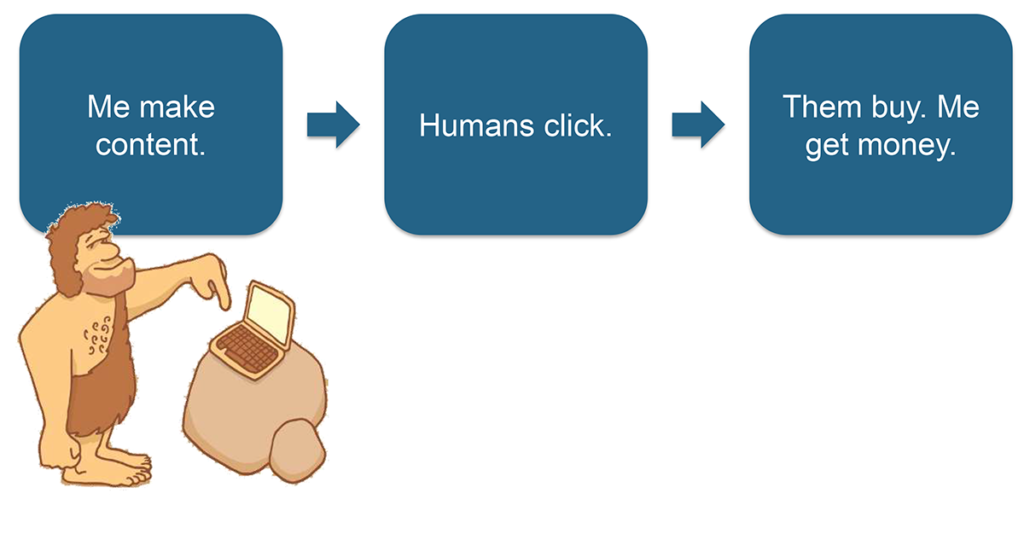
Too many businesses mistakenly assume that if they just create content, their potential customers will immediately see it, love it, and hand over their money. Unfortunately for all of us, it doesn’t work like that. Unless you give your customers a compelling reason to pay attention to your content, they’ll ignore you in favor of a more timely answer, a more in-depth resource, or a funny cat video.

You need to earn the attention of your customers by being hyper-relevant. That’s where your content marketing strategy comes into play. You need to research your target audience so you’re deeply in tune with what they need and how you can answer their questions. By learning where they hang out and how they consume content, you can also plan the appropriate content tactics to reach them in the right place at the right time.

Your Content is Tied to Your Other Marketing Efforts

Having a solid content marketing strategy isn’t just about doing content right. It’s about doing all of your marketing right. Content is the substance of message – the stuff your business’s story is made of. You can’t do marketing without content.

Furthermore, content is becoming more and more intertwined with SEO. In fact, it’s now one of Google’s top ranking factors. Google looks for well-written, highly relevant, long-form content when ranking your website. Waxing eloquent about your products and services isn’t enough anymore (because no one wants to read it). You need content that engages and informs your audience. Not only will it rank better, but it will also attract valuable backlinks to your website.

Social media is also driven by content. You use social media to connect and engage with your customers, but content gives you the substance to share and start the conversation. Again, you can’t have a conversation when you only talk about yourself, so you need relevant, non-promotional content.

In both cases, success comes back to having a solid, documented content marketing strategy. Optimized content for SEO and consistent engagement on social media doesn’t happen by accident.

You Need to Know Whether It’s Working

Documenting a content strategy means that you are establishing clear goals for your content, as well as a way to measure them. Without a strategy, it’s easy to fall into the trap of random acts of content that you can’t relate to your business objectives.

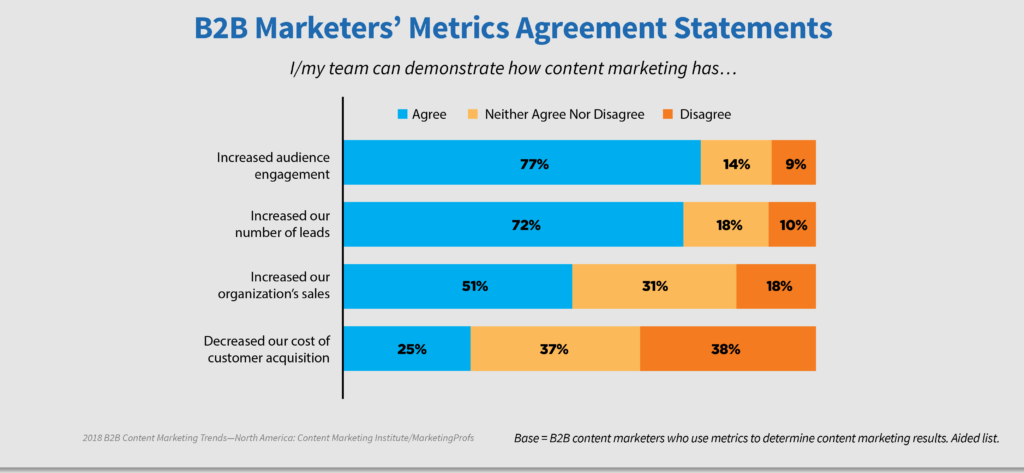
Only 35% of businesses measure the ROI of their content marketing, but those that do have metrics in place typically have positive results to share. 77% reported increased audience engagement, and 72% said they get more leads.

A documented content strategy gives you a roadmap for success so you can identify what’s working and what needs to be improved.

Start Building Your Strategy

If you don’t have documented content marketing strategy, it’s never too late to start! We’ve got multiple resources to help you on your way. First, check out the recording of our recent seminar: How to Transform Your Business with Content Marketing, download our e-book below, or contact us learn more about our expert content marketing services.

Download free e-book - Content Marketing 101

Read more

How Much Should You Spend on Google Adwords?

The blessing and the curse of PPC marketing campaign is that you can spend whatever amount you want. Google Adwords lets you set your maximum budget, with no minimum daily ad spend. So if you want to spend exactly $823.47 a month and not a penny more, you can. So the real question is: how much should you spend on Google Adwords campaign?

Read more

PPC Advertising: What Is It and How Does It Work?

 If you’re new to PPC marketing, it can be confusing to figure out exactly what someone means when they say “PPC.” Even if you’re already doing PPC marketing, knowing how the process works helps you understand your costs and how to get the most out of your investment. Let’s dive in!

What is PPC Marketing?

Pay-per-click is an online advertising model where, like it sounds, you pay every time someone clicks on one of your ads. PPC marketing is a paid alternative you can use to drive more traffic to your site, versus relying only on organic traffic.

Many different sites use a PPC marketing model, including Facebook, Twitter, LinkedIn, Bing, Yelp, Amazon and more. But when most people think of PPC advertising, they think of Google display ads, which is the most common platform.

In fact, Google captures a whopping 78% of the US search ad revenue. Each PPC marketing platform works slightly differently, but we’ll focus on the biggest fish and talk about how Google AdWords works.

PPC MARKETING on Google Adwords

Google didn’t become the largest PPC marketing system in the world by accident. Adwords gives you an incredible amount of control over where, when, how, and to who your display ads are presented. Not only that, but they have two powerful networks you can use:

The Search Network

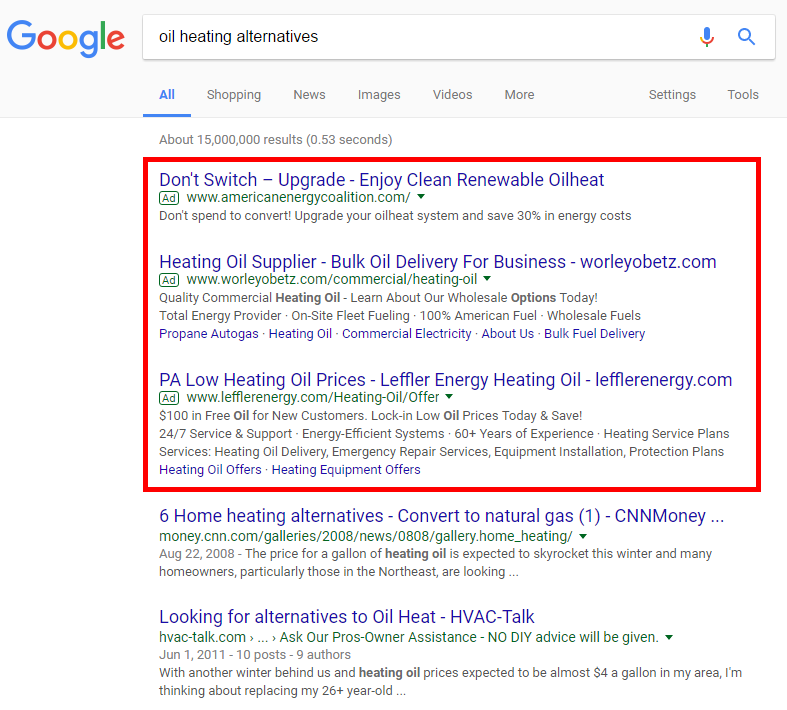
PPC advertising displays on Google’s search engine results page when a user searches for a related topic. Top paid results appear above the normal organic links. (Of the two networks, the search network is normally what people think of first when you say, “Google Adwords.”)
 

The Display Network

Through the Display Network, you can place banner ads on millions of websites, news pages, and blogs across the internet. According to Google, the network includes over 2 million sites, reaching 90% of global internet users.

Both networks fall under the Adwords umbrella, but you shouldn’t assume that the same ad will work equally on both networks. On the Search Network, users have a need and they are actively searching for information, products, or services to meet that need. They’re likely further along in the buying cycle.

In contrast, Display Network ads are reaching people who are on other sites and may not be looking for your product or service at all. Banner ads are by nature interruptive. They succeed when they are relevant enough and compelling enough to get someone to stop doing what they’re doing to click the ad.

How DoES PPC ADVERTISING Work?

While there are some variations between the Search and Display networks, both work essentially the same way.

First, you determine relevant keywords related to your product or service. Then, you determine a cost-per-click that you bid on those keywords.

The instant when a user performs a search, Google decides if your keywords are relevant to the search query. If so, the Ad Auction begins, where Google compares your ad against similar ads from your competitors.

The Ad Auction

The Ad Auction decides your Ad Rank, which determines where (or if) each ad appears. The advertiser with the highest ad rank gets placed first.

Ad Rank = Max CPC Bid x Quality Score

Ad rank is determined by multiplying your maximum cost-per-click bid by your ad’s Quality Score. Quality Score is Google’s rating (on a scale of 1-10) of how relevant and valuable your ad is. Google keeps the exact formula a mystery, but we know the key factors include:

  • Click-through rate
  • Landing Page quality
  • Relevant keywords
  • Relevant ad text
  • Historical Adwords account performance

Thankfully, PPC advertising isn’t just a pay-to-win system. By factoring in quality, you don’t necessarily have to be the highest bidder to grab the top spot. This is good news for small businesses, who can actually out-rank large corporations without paying a fortune.

Let’s say, for example, your CPC bid is $2.00. Your ad Quality Score is 8.

Your Ad Rank = $2.00 x 8 = 16

You’re competing a big corporation who bid $5.00, but their quality score is only 3.

Competitor’s Ad Rank = $5.00 x 3 = 15

Your Ad Rank is higher, so you will rank first, despite the fact that they bid more than twice as much as you. Take that, mega-corporation!

Your Actual CPC

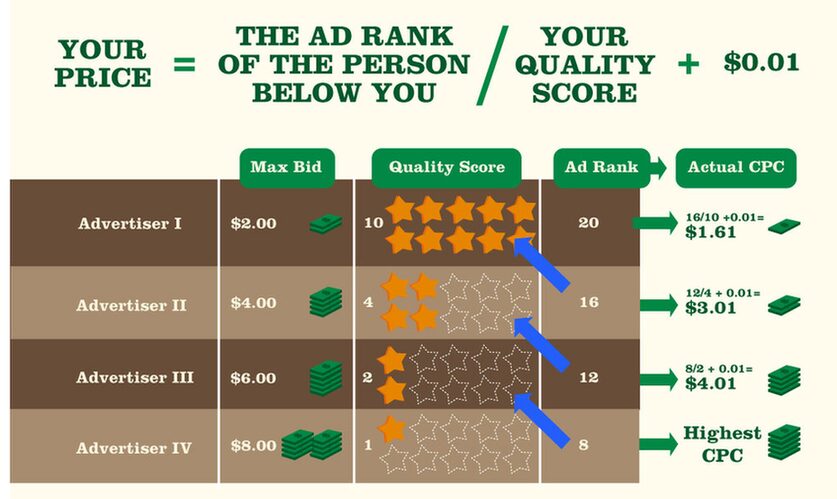
After the Ad Auction, Google compares your Ad Rank with your competitors to determine your actual cost per click.


Image Source: Wordstream


Good news: your actual cost per click is often less than your maximum bid.

Let’s say you’re Advertiser 1. Even though you’re willing to pay $2.00 for each click, you’ll only be charged $1.61. That’s even less than your competitor is paying for the spot below you!

What’s the lesson here? Your Quality Score is critical to getting a good ROI on your PPC marketing. A better Quality Score will boost your Ad Rank and reduce your cost per click. Increasing your bid will only improve your Ad Rank. So invest the time in developing quality ads and great landing pages – it’s the best way to ensure your PPC marketing is a success.

Want to Know How PPC marketing Can Help Your Business?

Check out our free e-Book: Using PPC to Improve Your Bottom Line. We go into more depth about the benefits of PPC advertising and how to put together a successful PPC marketing campaign. You can always talk to our PPC agency in Lancaster to get even more insights.


Read more

11 Web Design Myths

Every business today needs to have a good website design in order to succeed online and in the physical world. The design  of your website plays a huge role in how users view your business.

You may have heard from different web designers about what you should and shouldn’t do with your website. Here are our top web design myths to clear the air and help your site succeed!

Read more

10 Benefits Of Business Blogging

Blogging has been around since the beginning of the internet, but a lot of businesses still aren’t doing it. Either they don’t understand it, think it’s not worth their time, or they don’t have the resources to do it themselves.

If you’re not blogging by now, you’re not just behind the times, you’re in danger of extinction.  This year, a majority of marketers rated blog content creation as a top priority, according to Hubspot. Why? Blogging offers a ton of benefits to your business that you don’t want to miss out on.

Read more