Blog


Facebook Ads – Are They For You?

Facebook is like the social media elephant in the living room: it’s too big to ignore.  According to Social Media Examiner’s latest report, a commanding 93% of social marketers regularly use Facebook ads. Despite this, marketers are often unsure if their Facebook efforts are effective or not. When considering how to spend their precious advertising dollars, many businesses are still asking if Facebook ads are a good fit. Here are a few questions and common objections that will help you decide if you should be doing Facebook ads.

Are your customers on Facebook?

This is an objection we hear mostly from B2B businesses. “Facebook is great for B2C,” they say, “but my customers just aren’t on Facebook.” Is that really true?

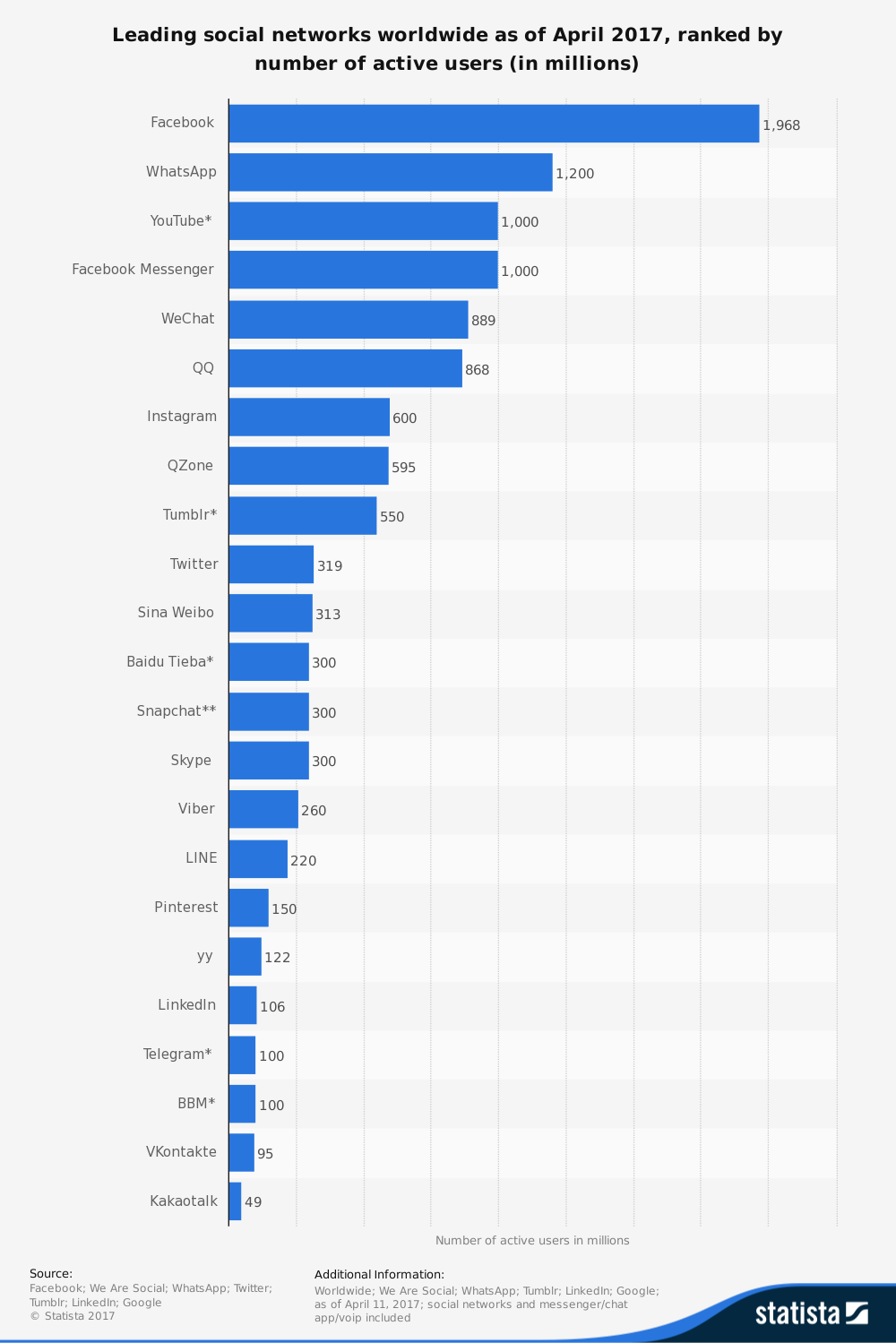
As of Q1 2017, there are 1.9 billion monthly active users on Facebook. Think about that for a minute. There are only about 3.7 billion Internet users worldwide, which means more than half of them are on Facebook. This number dwarfs the user count for any other social media platform. As you can see from the chart below, some of the closest competitors include WhatsApp and Facebook Messenger, both Facebook products.
https://www.statista.com/statistics/272014/global-social-networks-ranked-by-number-of-users/

Not only is Facebook’s audience huge, it’s also highly active. The company reported that users spend an average of 50 minutes per day on their apps (Facebook, Messenger and Instagram). When you think about people’s fragmented attention spans, that’s an enormous amount of time. In fact, Facebook accounts for one in every six minutes spent online.

With an audience that big and that active, it’s hard to believe that your customers just aren’t on the platform. Statistically speaking, unless you have an unusually niche audience who hates the Internet, your audience is probably on Facebook.

Can you reach your specific audience?

The great thing about Facebook is its astounding 1.9 billion users. The problem is that 1.9 billion is a pretty big haystack when your audience is a much smaller pile of needles. Thankfully, Facebook has highly advanced targeting capabilities so you can really hone in on your precise target audience.

Through partnerships with big data companies, Facebook provides sophisticated targeting that goes well beyond standard demographic and geographic criteria. You can reach audiences based on life events like getting married, having a baby or getting a new job. You can also target based on people’s behaviors, like buying a new car, travelling frequently or donating to charitable causes.

View the full infographic here.

Even better, Facebook allows you to create Custom Audiences based on people who have visited your website, or email and phone lists that you already have in your database. Layer in demographics like age, job function or geographic location to get hyper-focused. You can also use Custom Audiences to send retargeted messages to people who already know you, which helps increase conversions. Lastly, Facebook can create Lookalike audiences that have similar traits to your custom audience, allowing you to reach more people just like your Custom Audience.

Remember, there are great options here for B2B too. You can target based on job title, employer, company size, industry and more. The behavioral filters also let you narrow by business purchasing behavior, such as people who have purchased business repair/maintenance services. Of course, Custom and Lookalike audiences are a powerful tool for B2B as well as B2C.

Can you afford Facebook ads?

Budget is always a factor as businesses debate how to best spend their advertising dollars. Facebook ads are a popular choice in part because they are so affordable.

The average cost per click (CPC) for Facebook ads in the U.S. is about $0.28.  This is significantly lower than the average CPC for Google search or display ads, which are $2.32 or $0.58, respectively.

Compared to other advertising methods, Facebook provides an immense opportunity at an extremely affordable price. In fact, the minimum ad spend on Facebook is just $1 per day. A recent blog article from Moz makes the case for Facebook ads, showing how just $1 can get your business in front of 4,000 people per day.
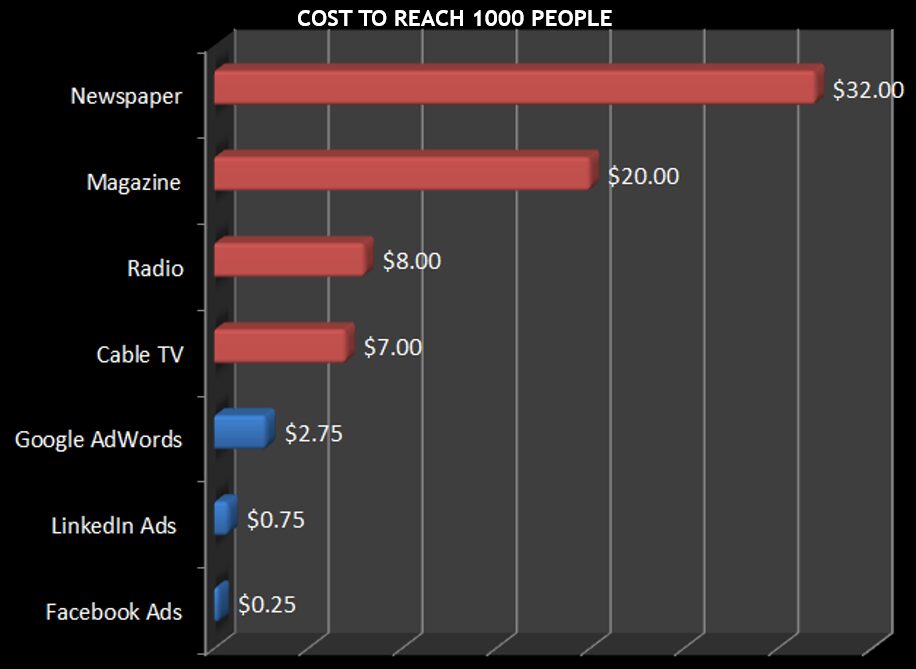
Of course, many businesses will want to invest more than $1 per day in order to drive more significant results. Regardless, as the author says, “If you can’t spare $30 a month, you shouldn’t be in business.”

Do you really need them?

If you already have a great Facebook business page with tons of followers and engaging posts, maybe you’re thinking you don’t need Facebook ads. Or, perhaps you’re investing in other social channels and don’t want to add Facebook into the mix. Think again.

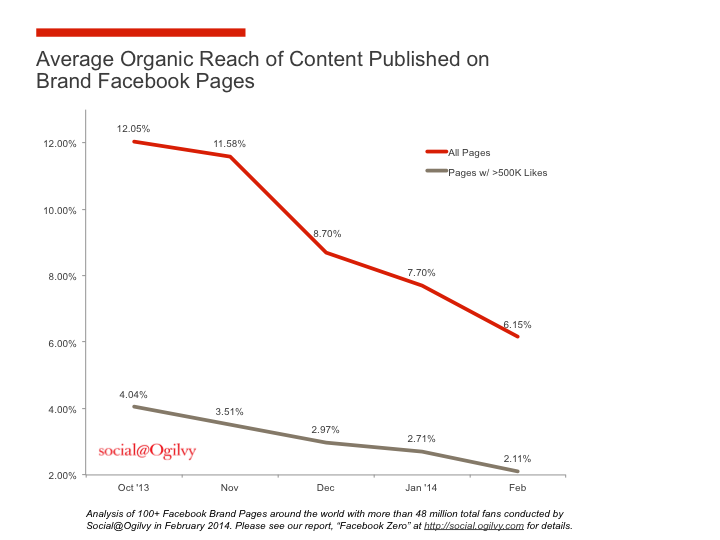
Facebook has become notoriously “pay to play,” with organic reach plummeting to as low as 2% and continuing to drop. Businesses can no longer count on only regular posts on their business pages to reach their audience. Like it or not, paid promotion is now a necessity to drive results on Facebook.
If you don’t like “pay to play,” why not avoid Facebook entirely? The problem is that Facebook is the gateway to the ever-growing mobile audience. Facebook boasts 1.5 billion mobile users, of whom almost 900,000 log in exclusively via mobile. This gives Facebook one of the largest mobile-exclusive audiences in the world. So if your customers are browsing on mobile, you should definitely be considering Facebook ads.

Do Facebook ads work?

This is the ongoing debate. Despite the number of businesses who use Facebook ads, many don’t feel like their ads are working. There are a variety of reasons for this.

Remember that Facebook is a social network, and advertising there is fundamentally different than AdWords. People aren’t on Facebook to buy your products or download your new e-book. They’re there to see photos from friends,  to keep up with news, to share what’s important to them. Bottom line: they’re not necessarily in a buying mood.

So what does that mean for  you? First, make sure your approach is focused on promoting content that is truly compelling, entertaining, or shareable, not just pushing your sales message. Your message needs to be highly compelling and highly clickable to compete with funny cat videos.

Second, make sure your goals are realistic. If you have an e-commerce business, direct sales ads may work for you. For many others, Facebook is more effective for uses like brand awareness, engagement or lead generation.

Lastly, many Facebook ads fail because they are not properly targeted. Facebook has such immensely powerful targeting capabilities, they’re almost creepy. (If you don’t believe me, check out this example of a guy who used Facebook ads to prank his roommate). Make sure you’re taking advantage of these powerful tools.

Implemented correctly, Facebook ads can be extremely successful and highly cost effective. Facebook has a ton of case studies to prove it.

Wrap up: should you advertise on Facebook?

Simple answer: probably. Even if Facebook isn’t a core part of your business strategy, it offers enormous potential benefits with an extremely low cost of entry. Of course, there are always variables an exceptions to the rule, but overall if you can spend a couple dollars a day to leverage an audience of billions to get in front of your precise targeted audience, why wouldn’t you?

Next Steps

Need help getting started? We’d be happy to sit down with you for a free no-risk, no-obligation Facebook review.

Schedule your FREE Facebook Audit, which includes:

  • Review of your current Facebook business page
  • Suggestions to improve your posting strategy
  • Review of your current ad strategy (budget, targeting, content, etc)
  • Research of potential target audiences & reachStart A Conversation

Read more

3 Ways Heatmaps Can Improve Your Website Conversions

With the first quarter coming to a close, it’s clear that the industry experts were correct in suggesting data and analytics will drive the industry in 2017. Not only do marketers have more access to compelling data than ever before, they also have tools to analyze it, interpret it, and put it to use.

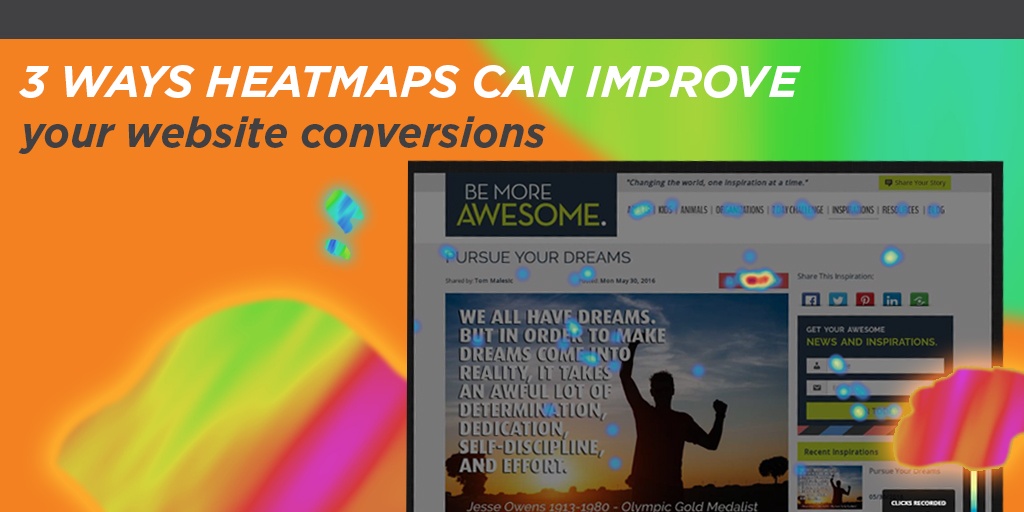
One of the most useful data gathering and aggregating tools is called a “heatmap.” A heatmap shows how visitors interact with a webpage: where they look, what they click on, and how they scroll. The red or “hot” areas of the map represent the greatest amount of activity.
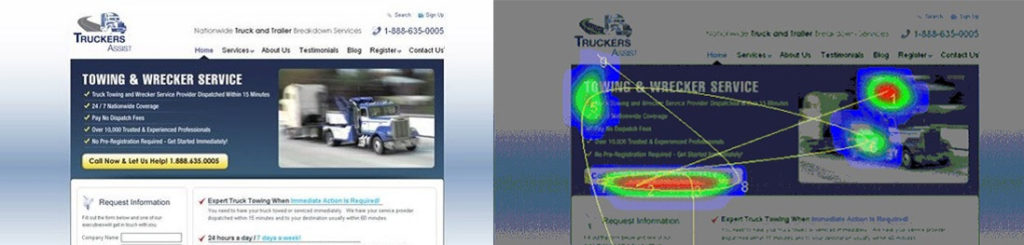
Heatmaps provide real-time information to marketers seeking to respond to industry changes and trends as quickly as possible, making it easier for the customer to find what they’re looking for and eventually convert to a sale.

Here are just a few ways heatmaps can help you optimize your website design and improve conversions.

1. Identify where users become confused

One of the most common sources of confusion on a website is the navigation bar. After all, this is where a user is intuitively trained, for better or worse, to look seek out information (hence its name). If a visitor to your website is spending a lot of time hovering around the navigation bar, it’s reasonable to assume that they’re not sure where to click. They are confused.

While there are a variety of factors that result in nav-bar confusion, a few are very common. Perhaps it contains too much information to digest, it’s unnecessarily cluttered, the text is too small to read, or drop-down menus are difficult to click.

According to some case studies, removing the navigation bar all together is the key to greater success. Consider the type of information your user is looking for—is the navigation bar necessary to lead them there, or would a simple call to action suffice?

2. Test your calls to action

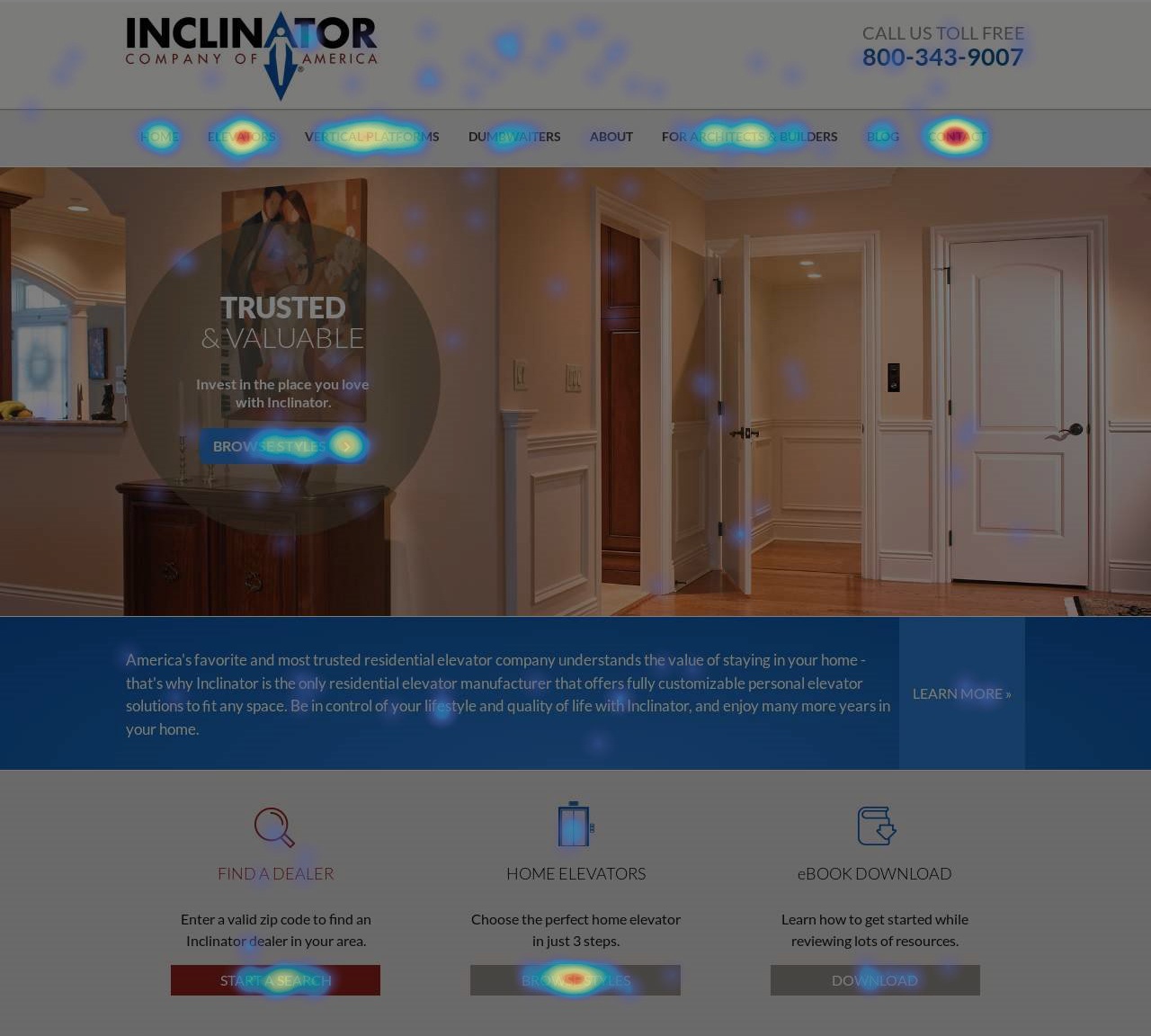
What if your CTAs simply aren’t generating clicks? A heatmap will show you if users are noticing your CTA buttons, if they’re hovering over or near them before making an action, and what action they’re likeliest to take afterward.

In the example below, you’ll see that the landing page was optimized with an effective call to action. The heatmap shows how the CTA button clearly receives the most attention on the page.

Heat Map Example

Source: Kissmetrics

Furthermore, a “click map,” featured in most heatmapping software, can show you whether your CTAs are actually generating clicks, and if those clicks result in additional actions. A click without a form-fill is, however, just a click!

The bottom line is that calling a visitor to action doesn’t amount to much if the visitor doesn’t click. (We discuss this in our upcoming Conversion Marketing Seminar.) Split-testing your CTAs is critical when you’re trying to determine their effectiveness. Placement, color, text, size, and many other factors can make the difference between a strong call to action and a weak one.

3. Discover which parts of your Web Design should be optimized

We’re in an age of rapid change, and yesterday’s tools are no longer adequate to engage consumers and drive conversions. In a sense this means your website design should be adapting to the viewer on a moment-to-moment basis.

Such intuitive web content is of course difficult to create and maintain on the fly. What you can do, however, is use heatmapping to determine the parts of your site that can be optimized. This is known as conversion rate optimization, or CRO.

This allows you to challenge conventional wisdom and see what works best for your visitors. Should the most important information appear above the fold? (Maybe not!) What’s causing visitors to abandon their shopping carts? How do numbers trigger the likelihood of a purchase?

When you use heatmaps to answer questions like these, you no longer need to rely on anecdotal data, or even the hard data of other businesses. Your customer is your customer, and your job is to cater to their needs, not the people visiting another website.

Want to learn more about how to design and optimize your business’s website? Check out our business web design guide!

Start A Conversation

Read more

Local Visibility Packages: What to Know About Local SEO

Local search visibility can be improved by optimizing your local SEO, which includes syncing accurate business information with the many directories and sites out there that lists those businesses. Furthermore, it’s about working to increase your online visibility, particularly as it concerns local SEO marketing.

Aside from having your business info (name, address, phone number) displayed on a directory listing, reputation management and ongoing maintenance of your business info is crucial to establishing you as a credible business in the eyes of search engines.

Listing accuracy is vitally important. Inaccurate listings not only harm the business they’re for (if they’re active), but they can damage the trust Google has worked so diligently to foster between users and the search engine.

Moz Local’s George Freitag summed up listing accuracy nicely when he said:

Listing accuracy is Google’s method for determining whether Google can trust a local business result.

To obtain listing accuracy, Google relies on a number of places to find your information including phone directories and phone books, directories for specific sites, review websites, news websites, government websites, and more; and each time one of these locations mentions your business info, it increases Google’s confidence in the information you’ve provided.

Similarly, when a site or directory lists a variation of the details you’ve provided about your business—such as the wrong address or phone number, or an address/business name listed in a different format or variation—it decreases Google’s confidence in the validity of the business information, making it less likely to show your business in local results.

And why? Because Google wants to maintain the trust between its search engine and the users, since if too many users are dialing the wrong business number or trying to find businesses that don’t actually exist, people are less likely to trust Google’s results.

What’s worse is that if enough online sites provide contradictory information to what you’ve given for your business, that inaccurate information could override the details you’ve listed, forcing Google to trust these other sources more than your business. In the case of store hours or address, this can be a huge detriment to your business.

Image result for local visibility meme

A breakdown of what you need to do to improve your local SEO visibility:

  • Create your Google “My Business” listing.
  • Find all of the variations and instances of your NAP (name, address, and phone number).
  • Fix all instances of your NAP to reflect the correct business info you’ve provided in your Google My Business listing.

The real problem, as you can imagine, is finding every instance of your NAP and correcting it. This actually amounts to a tremendous amount of work, both searching for and correcting any aberrant mentions of your business. You might not have the know-how or time to do this work yourself, which is where a primary data provider comes in. We’ll talk about those after we get into your NAP.

Understanding the importance of your NAP and how it affects local SEO results

Providing your NAP by creating a Google “My Business” listing should be your first step, way before you dive into any kind of directory, review site, or phone book.

Before you start listing your information on other sites (citations), you need to find any and all existing NAP variations on the web and correct them for accuracy. Building local citations before you correct the NAP variations could create conflicting data for Google who may not trust that your business is legitimate, and may neglect to include it in local SEO marketing results.

Your business’ name, address, and phone number are important for a number of obvious reasons, from helping people get in touch with you and actually visiting your brick-and-mortar location, to making it easier for your audience to identify your brand.

For example, if your business is The Amazing Hotdog Factory, but you find variations for The Hotdog Factory, The Amazing Hotdog, and Amazing Factory of Hotdogs, people won’t know what to call your business, and Google will feel the same way.

To start searching for NAP variations, go to Google and start searching for your company name, your phone number, and parts of your address to see where your business info might be appearing. You can also do site: searches through Google, looking through specific sites for mentions of your NAP. If a website has a search function, you can also use that to search for duplicate/NAP variations.

Sound like a lot of work? It can be, but you also have the option to hire a third-party primary data provider capable of doing the work for you, and then some.

What a “Primary Data Provider” can do for your local  search results

A primary data provider is someone you can go to and they will do the hard work of correcting your listing accuracy for you. Most providers have an extensive network of directories and listings they can search for mentions of your business info and then correct any inaccuracies should they come up.

graph

The benefit to this is helping you establish that confidence in Google to trust the information you’ve provided. Once Google trusts your info, it feels confident enough to plug in your business info into local SEO results. Before you ask if that’s all it takes to fix the problem and cause you to appear more in relevant local SEO results, remember: sites change all of the time, and new ones are being created daily. Ensuring all citations—mentions of your NAP located on the web—remain consistent, a primary data provider will regularly check all sites in their network to maintain accuracy.

While they take care of the work of managing citation accuracy, a primary data provider may also put your business info on other sites you haven’t already appeared on, which is a benefit of the provider’s existing network. All of these extra sites that list the correct name, address, and phone number further increase Google’s confidence in your business’ legitimacy and it has a greater chance of appearing higher in local search results.

Optimizing local SEO contributes to better brand visibility and reputation

Another part of local SEO marketing is reputation management. This involves managing feedback, reviews, or comments left about your business or products on review sites such as Yelp or Angie’s List, as well as social media sites where your audience might be able to reach you. Reviews are often visible in local SEO results, and if you have reviews, comments, or questions not being addressed, it can be damaging for your business.

Local SEO marketing is sometimes neglected by businesses who think they can just rank well in Google and be seen by their target customer, but because Google actually differentiates global and local results, it can be a huge mistake to neglect this part of your optimization efforts. If you’re struggling to rank well in local results or can’t manage to correct all of the many NAP variations for your business, we also specialize in dealing with local SEO and business directory listings. Talk with our website design and SEO agency now.


Read more

Does Your Website Have a Solid Customer Journey?

“Customer journey” is a sticky term, a bit difficult to understand or define. The simplest explanation comes from SurveyMonkey, a data collection, data analysis, survey, and brand management tool for businesses.

The customer journey is the complete sum of experiences that customers go through when interacting with your company and brand. Instead of looking at just a part of a transaction or experience, the customer journey documents the full experience of being a customer.

For businesses with a strong digital presence (which includes most businesses in this day and age), customer journey is only becoming more important. Many customer journeys may begin or end off of your website, but your web presence is a critical factor in helping your customers achieve a desired outcome while also  taking the next step towards buying your products or services. The problem with the process of “customer journey mapping” is that every business guides its prospect through a different customer journey. Consider just two very basic examples:

  • A B2C artisan cupcake shop without an e-commerce website, relying heavily on traditional advertising word-of-mouth for traffic to their brick-and-mortar store.
  • A B2B heavy equipment rental company that offers custom quotes through its website for large commercial and industrial construction jobs.

These companies exist in completely different industries. They have completely different sales goals. The cost of acquiring a new customer, and that customer’s lifetime value, can’t even be compared. In other words, their customers’ journeys don’t have too much in common from the point they enter the sales funnel to the point when they make a purchase.

But this doesn’t mean that you can’t refine your customer journey on the web. Because they’re your customer, you already have a great idea of what their needs and desires are! By asking the right questions, looking at the right data, and seeking the right advice, you can more effectively guide your customer through a pleasant experience that will lead them to where they want to go (and where you want them to go, as well).

Here are just a few questions you can ask yourself to see if you’re offering your customer an amazing journey when they interact with you on the web.

How do you define your customers?

While your customers have one huge things in common—they want your products and services. However, they’re unique in the ways that they receive and consume the information you disseminate that may result in a lead, conversion, or sale. Furthermore, you probably have repeat or high-value customers, or a customer base that you’d like to tap into more.

These customers can be broken down into “buyer personas,” fictional representations that represent the way your different customers interact with your brand.

Man-Running-Outside-Along-Desert-Trail

Once you’ve defined your customers, it’s time to take a walk in their shoes. When they arrive at your website, what information are they going to be looking for? Is that information provided to them in an easy-to-understand way, or will it be difficult to find?

One of the things that you want to provide your ideal customer is a pleasant experience—the feeling that they’ve accomplished what they set out to do when they began their journey (whether online or offline). Someone who feels satisfied at the end of their journey is far likelier to visit you again.

What goal(s) are you looking to achieve?

Everyone measures success differently. For example, a long sales cycle might mean that you’re looking for many more “micro conversions” (social interactions, form fills, downloads, chats, or emails) before the ultimate “macro conversion” (the sale!).

Although your ultimate goal is the sale, there are probably other goals to set before you can expect your prospect to buy.

The sale happens at the end of the journey. Does your website—or your web presence as a whole—facilitate those micro conversions? Some things you may want to consider is whether you’re providing easy-to-find, easy-to-consume information that will develop trust between you and a prospect and allow them to take that next step down the conversion funnel. You’ll also want to ensure that your site provides multiple outlets for your customer to get answers to questions they may have, whether through chat, email, or social.

What paths can your customer take?

There are (as we will explain in the next point) many paths to any destination. Some of these paths are quick and easy. Others are difficult and take too long. Your challenge is to ensure that your customer has multiple paths to their destination and that those paths are clear of obstacles.

Tree-Lined-Road-In-England

Think about a “bad customer journey” experience you’ve had online. Perhaps you went to a website looking for something specific and you couldn’t find the information you needed, or weren’t able to take the action you wanted to accomplish.

Navigating a website can be extremely frustrating when customer journey isn’t taken into account. If it takes too many clicks to find what you’re looking for, if the navigation is confusing, or if there aren’t enough easy-to-follow paths to reach the desired destination, customers are likely to bounce to another website with a better user experience and a simpler, more pleasant journey.

Where does your customer journey begin and end?

Everyone’s journey is different. All those cars in a Target parking lot began at a different place, took a different path to get there, and were driven by people with different goals once they reached the store. Some of them find what they want quickly. Others have a difficult time tracking down what they’re looking for. Of course, some people won’t find what they need and will need to extend their journey to a different destination.

As we’ve said at the beginning of this post, the customer journey for some businesses begins offline and ends at a brick-and-mortar store. For others, the journey occurs entirely on the website. Most businesses, however, have multiple touch-points along the journey, and their website is one of the paths they take to achieved their desired outcome.

Consider where your customers’ journey may begin, and where it may end. Remember, just as there are multiple paths, there are also multiple start and end points. Are you making sure to take care of the customer whose journey might begin before typing your business’s name into Google’s search bar? Does your website facilitate a smooth transition to the multiple destinations they may be looking to reach?

Which brings us to the final, critical point…

Do you understand the data?

If you’re able to answer the above questions, then you’re well on your way to refining your customer journey. However, the single most important thing you have to understand to create a seamless customer journey is data.

Your website’s analytics are full of information that will help you to understand how customers are interacting with your website and whether their journey is an enjoyable or a frustrating one. How many pages does the average visitor view? What’s your website’s bounce rate? What is the duration of the average visit? How many visitors return?

data

You can, and should, go even deeper. Mobile experience, page load times, social interactions, and more are all valuable data points that will help you refine your customer journey. Focus groups and mystery shoppers can help you iron out wrinkles you may have missed. Services like Hotjar can allow you to see heatmaps, visitor recordings, conversion funnels, and form analysis.

This information is invaluable when determining what parts of your site are easily navigable and what parts are confusing.

Any obstacle that prevents your customer getting from point A to point B is known as friction. The less friction, the better the journey. Data gives you the power to reduce friction and increase customer satisfaction.

Know what you don’t know.

Customer journey is a simple concept, but in execution, it can often be daunting. There are many, many things you can do on your own to improve customer journey on your website. However, there are times when calling an expert to help you fill in the details is the best chance you’ll have at success.

Business owners (and employees) can often be “too close” to their brand, meaning they don’t see customer journey the way their customers do. An unbiased look from outsiders who can view things through the eyes of your customer will help you to see areas where you’re doing a great job and ones that may need some improvement.

The good news is, with an awesome customer journey, not only will you generate more conversions and sales—you’ll create an enjoyable experience, have satisfied customers, and develop affinity toward your brand. Our marketing agency in Lancaster, PA can help. We help small businesses with website design, SEO marketing, and search engine optimization.

Read more

5 Key Takeaways from the 2017 CMI B2B Report

The most recent B2B content marketing benchmarks, budgets, and trends report for 2017 is out. Here are a few interesting key takeaways to take from the report.

1. Content marketing spend vs. increasing amount of original content

img1 img2

Of those polled, 70% said they expected to be generating more unique content, but only 39% of those expected to increase their marketing spending. If you’re wondering how so many marketers expect to generate more original content for the same amount of spend, consider optimizing existing content to boost site traffic.

Content audits are a great way to capitalize on work you’ve already done while keeping your content fresh and relevant to readers and search engines. Besides, there’s little point to inundating a website or campaign with more content if your old content is still performing well. In the case of original content vs. new content, less is more as long as the content is high quality. Refreshing old content is, generally speaking, more preferable than generating brand new marketing material if you are still seeing a high return on your investment on creating that content.

2. Content marketers are going after lead generation and brand awareness

It’s integral to any marketing campaign to establish clear goals early. Goals are how your company will gauge the success of its content marketing, but also how it will direct those same marketing efforts.

img3

Lead generation is a logical goal for marketers, and so is increasing your brand awareness; but the interesting part is that fewer than 45% of marketers are worried about creating brand advocates. Never underestimate the power of customer evangelism because if you aren’t encouraging positive feedback or providing your audience with a space to build that fan base, then you’re missing out.

We’ve talked about relationship management before and how it can be used to frame public perception of your brand, so if you’re not actively engaging with your customers and managing the relationship your brand has with them, you’re losing an opportunity to have others help to expand your brand awareness.

With social media, viral videos, and brand enthusiasts, it’s never been easier to increase the reach of your brand. If you have customers out there spreading word of how awesome you are, doesn’t that kind of tie into generating new leads as well? The more people who know about you, the greater your opportunity for new leads.

3. Email isn’t dying as quickly (or at all) as some marketers believed

There’s been a deal of consternation among industries as to whether email is a dying marketing channel, or if it’s simply being wasted on the younger generation. Despite the many varied articles and blogs regarding the topic, the marketers polled by CMI—93% of them—were utilizing email to distribute their content.

img4

4. Social media is still top of its game as a go-to marketing tactic

While content marketers are still using an array of tactics, social media is being used by more than 80% of them, which isn’t really a huge surprise. With the changes Facebook made to its business pages and platforms like LinkedIn for B2B businesses, social media is an ideal channel and tactic for content marketers.

img5

It’s also important to note the continued popularity of infographics and whitepapers. These tactics are fairly evergreen, as well as being a reliable way to get backlinks. Remember that whole ‘less is more’ line from earlier? Well, implementing a few updates to an existing (but potentially out of date) eBook, whitepaper or infographic can make it good as new again, or in the case of content marketing, relevant.

5. Site traffic the leading metric for content marketing measurement

img6

Content marketers have been using website traffic as a metric to measure results of their content marketing efforts, but they’ve also been paying attention to sales, the quality of those sales leads, and conversion rates. You could argue that it’s strange to see how few marketers cited higher conversion rates or even SEO rankings as a metric. Nevertheless, it’s interesting to see that despite social media content being one of the top tactics being used, only 22% are using social media sharing as a metric of measure.

Marketing trends come and go, but paying attention to what we’ve been doing as content marketers is the only way to adjust course when we notice patterns that really aren’t optimizing tactics that work.

Download free e-book - Content Marketing 101

Read more